Propagating herb and spice seedlings is a fundamental step in establishing a successful open environment production system. This process demands careful attention to occupational safety and health to protect workers from hazards associated with handling tools, chemicals, and biological materials. In Kenya, where smallholder farmers and commercial horticulturists operate under diverse conditions, ensuring safe working environments is critical to maintaining productivity and meeting regulatory requirements. This chapter explores the procedures necessary to uphold occupational safety and health standards during the propagation of herbs and spices seedlings.
1.1 Procedures for Occupational Safety and Health
Occupational safety and health (OSH) in horticulture involves a combination of practices and protocols designed to prevent accidents, injuries, and illnesses among workers. In the context of propagating herbs and spices seedlings, hazards can arise from chemical exposure, use of sharp tools, ergonomic strain, and environmental conditions. Kenyan horticulture professionals must understand and implement OSH measures that align with national laws such as the Occupational Safety and Health Act (OSHA) 2007, as well as guidelines from the Ministry of Labour and Social Protection. Proper OSH procedures not only safeguard workers but also promote efficient production and sustainable farm management.
1.1.1 Identification and Assessment of Hazards in Seedling Propagation
Recognizing potential hazards in the propagation environment is the first critical step in occupational safety. Hazard identification involves systematic examination of all activities and materials used during seedling propagation to detect sources of harm. For herb and spice production in Kenya, common hazards include sharp cutting tools, exposure to pesticides and fungicides, repetitive motions, and slips or falls due to wet surfaces.
Types of Hazards Common in Propagation
- Mechanical Hazards: Use of knives-pruning shears, and other cutting tools poses risks of cuts and puncture wounds. For example, farm workers at a Nairobi-based herb nursery must regularly inspect and maintain tools to avoid accidents.
- Chemical Hazards: Handling pesticides or rooting hormones without adequate protection can cause skin irritation, respiratory problems, or poisoning. Workers at a spice propagation site near Mombasa often apply fungicides to seedlings, necessitating strict adherence to safety protocols.
- Ergonomic Hazards: Repetitive tasks such as transplanting seedlings or carrying heavy trays can lead to musculoskeletal disorders. In Kisumu, farm laborers have reported back strain due to improper lifting techniques.
- Biological Hazards: Contact with soil-borne pathogens or allergens can cause infections or allergic reactions. Smallholder farmers in Meru experience frequent exposure to such biological agents during seedling handling.
- Environmental Hazards: Working outdoors exposes personnel to extreme weather conditions such as intense sun or heavy rains, which can contribute to heat stress or slips.
Assessment Procedures
- Conduct regular workplace inspections to identify and record hazards.
- Engage workers in hazard reporting to capture all potential risks.
- Use risk assessment matrices to prioritize hazards based on likelihood and severity.
- Review incident and near-miss reports to detect emerging hazards.
- Consult OSH experts or extension officers for specialized hazard evaluation.
1.1.2 Use and Maintenance of Personal Protective Equipment (PPE)
Personal protective equipment is a critical barrier between workers and occupational hazards during seedling propagation. The correct selection, proper use, and regular maintenance of PPE ensure its effectiveness in preventing injuries and illnesses.
Types of PPE Relevant to Seedling Propagation
- Gloves: Protect hands from cuts, chemical exposure, and soil-borne pathogens. For instance, workers at a herbal farm in Nakuru use nitrile gloves when applying rooting hormones.
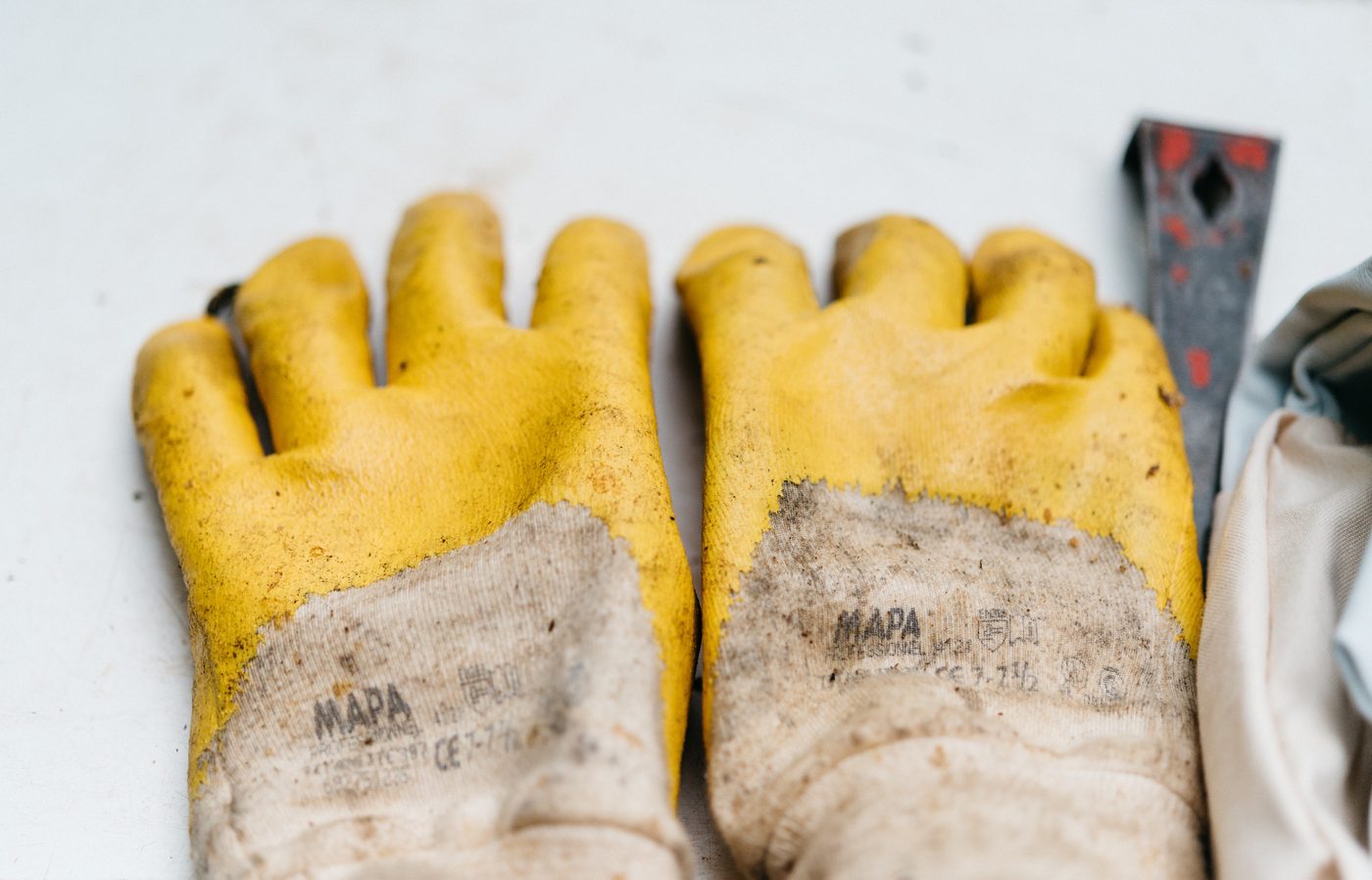
Pair of yellow work gloves used in carpentry (Source: Wikimedia Commons)
- Eye Protection: Safety goggles shield eyes from splashes of chemicals and debris during transplanting.
- Respirators or Masks: Used to avoid inhalation of dust, spores, or chemical fumes, especially in enclosed propagation areas.
- Protective Clothing: Long-sleeved shirts and aprons reduce skin contact with irritants and provide a physical barrier.
- Footwear: Waterproof boots prevent slips and protect feet from sharp objects or exposure to wet soil.
Proper Use and Maintenance Practices
- Select PPE that fits properly and suits the specific hazards involved in seedling propagation.
- Train workers on correct donning and doffing techniques to avoid contamination.
- Inspect PPE before each use for damage such as tears, cracks, or worn straps.
- Clean reusable PPE according to manufacturer instructions to maintain hygiene and functionality.
- Replace disposable PPE after single use or when compromised.
1.1.3 Safe Handling and Storage of Chemicals and Tools
Chemicals such as pesticides, fungicides, and rooting hormones are vital in herb and spice seedling propagation but require careful handling to prevent occupational hazards. Similarly, sharp tools must be managed to avoid injuries.
Safe Handling Procedures
- Read and follow labels and safety data sheets for all chemicals before use.
- Use measuring and mixing equipment to avoid direct contact and spills.
- Apply chemicals in well-ventilated areas to reduce inhalation risks.
- Employ appropriate PPE when handling or applying chemicals.
- Avoid eating, drinking, or smoking in areas where chemicals are used.
Safe Storage Practices
- Store chemicals in locked, clearly labeled containers away from direct sunlight and moisture.
- Separate incompatible chemicals to prevent dangerous reactions.
- Keep tools in designated storage areas with protective sheaths or covers.
- Maintain an inventory log to monitor chemical quantities and expiry dates.
- Train workers on emergency procedures in case of chemical spills or exposure.
1.1.4 Implementation of Ergonomic Practices to Prevent Injuries
Ergonomics involves designing work tasks and environments to fit workers’ physical capabilities, reducing strain and injury risk. In herb and spice seedling propagation, repetitive movements and awkward postures can lead to cumulative trauma disorders.
Ergonomic Principles for Propagation Activities
- Workstation Design: Arrange work tables at heights that minimize bending or stretching. For example, a seedling nursery in Eldoret uses adjustable tables to accommodate different worker heights.
- Tool Selection: Use ergonomically designed tools with cushioned grips to reduce hand fatigue.
- Task Variation: Rotate workers between different activities to avoid repetitive strain.
- Proper Lifting Techniques: Train workers to lift with their legs, not their backs, and to seek assistance for heavy loads.
- Rest Breaks: Schedule regular short breaks to allow muscle recovery during intensive propagation tasks.
Benefits of Ergonomic Interventions
- Reduced incidence of musculoskeletal disorders among nursery workers.
- Enhanced worker comfort and morale, leading to increased productivity.
- Lower absenteeism and medical costs related to work injuries.
- Compliance with occupational health standards set by Kenyan authorities.
- Promotion of a safety culture that values worker well-being.
Practice Questions
-
Explain five types of hazards commonly encountered during the propagation of herb and spice seedlings and how they can affect workers. (10 marks)
-
Describe six key steps in the safe handling and storage of chemicals used in seedling propagation. (12 marks)
-
Discuss the importance of personal protective equipment in herb and spice seedling propagation and identify five types relevant to this activity. (10 marks)
-
Outline six ergonomic practices that can be implemented to prevent injuries among workers in a herb nursery. (12 marks)
The rest of this chapter
🔒Create a free account to open more of this chapter.
Free: practical guides, quick cards, workplace scenarios and more.
Create a free account 🔒1.2 Market Survey on Suitable Herbs and Spices
In Kenya, the cultivation of herbs and spices offers significant economic opportunities for horticulture professionals. Conducting a market survey is a critical step before propagation, as it informs growers about demand trends, consumer preferences, and poten…
🔒1.3 Planting Materials
In the production of herbs and spices under open environments in Kenya, selecting appropriate planting materials is critical to achieving healthy seedlings and successful crop establishment. Planting materials influence germination rates, seedling vigour, pest…
🔒1.4 Uses of the herbs and spices
In Kenya, herbs and spices are cultivated not only for their culinary appeal but also for their economic, medicinal, and cultural value. Horticulture professionals engaged in the production of herbs and spices must understand the diverse applications of these…
🔒1.5 Basic Plant Anatomy
Understanding the basic anatomy of plants is fundamental for horticulture professionals engaged in propagating herbs and spices in the open environment. In Kenya, where diverse climatic zones influence plant growth, knowledge of plant structure helps in select…
🔒1.6 Classification of Herbs and Spices
In Kenya, herbs and spices play a vital role in both culinary and medicinal applications, contributing significantly to the horticultural sector. Proper classification of these plants enhances understanding of their cultivation requirements, propagation method…
🔒1.7 Tools, Equipment, Supplies and Materials
In the propagation of herb and spice seedlings in open environments, the selection and proper use of tools, equipment, supplies, and materials is fundamental to achieving healthy and vigorous plants. In Kenya’s diverse horticultural settings, ranging from smal…
🔒1.8 Soil and Water Conservation Measures
In Kenya, particularly within horticulture, soil and water conservation is essential for the sustainable production of herbs and spices in open environments. The country's varying climatic zones and increasing pressure on land resources make conservation pract…
🔒1.9 Soil Sterilization
In Kenyan horticulture, especially in the production of herbs and spices under open-field conditions, soil sterilization is a critical practice that ensures healthy seedling development. Contaminated soil can harbor pests, pathogens, and weed seeds that compro…
🔒1.10 Soil Erosion Control Measures
Soil erosion poses a significant challenge to the sustainable production of herbs and spices in Kenya's open environments, particularly on sloping lands and during heavy rainfall seasons. Loss of topsoil reduces soil fertility, affecting seedling growth and cr…
🔒1.11 Types of Nurseries
Nurseries are specialized environments where young plants, including herbs and spices, are raised until they are strong enough to be transplanted into the field. In Kenya, the choice of nursery type significantly affects the quality and survival rate of herb a…
🔒1.12 Factors to be considered for site selection for nurseries
Selecting an appropriate site for establishing a nursery is a critical decision in the propagation of herbs and spices. In Kenya’s horticultural sector, where climatic variability and resource availability differ widely, choosing the right location influences…
🔒1.13 Nursery Bed Preparation
Nursery bed preparation is a fundamental step in propagating herb and spice seedlings in an open environment. Properly prepared nursery beds ensure optimal conditions for seed germination and early growth, which directly affects the quality and uniformity of t…
🔒1.14 Propagation materials
Propagation materials are the essential inputs required for producing healthy herb and spice seedlings in open environments. In Kenya's horticultural sector, the choice and quality of propagation materials directly influence seedling vigor, survival rates, and…
🔒1.15 Nursery Management Practices of Irrigation
Proper irrigation management in herb and spice nurseries is essential to ensure healthy seedling development and optimize water use efficiency. In Kenya’s diverse climatic regions, from the humid coastal areas to the semi-arid zones of Eastern Kenya, irrigatio…
🔒1.16 Record Keeping
In the propagation of herb and spice seedlings, meticulous record keeping is a fundamental practice that ensures traceability, quality control, and efficient resource management. In Kenya’s horticulture sector, where smallholder farmers and commercial enterpri…
🔒1.17 Waste Management Practices
Effective waste management is critical in the production of herbs and spices in open environments to ensure sustainable horticultural practices, environmental conservation, and compliance with Kenyan environmental regulations. Poor waste disposal can lead to s…
🔒1.18 Emerging trends- Automated sowing machines
The adoption of automated sowing machines in herb and spice seedling propagation is transforming horticultural practices in Kenya. These machines enhance precision, efficiency, and uniformity in sowing seeds, which is critical in large-scale production environ…
Chapter Summary
This chapter covers essential procedures for occupational safety and health that ensure a safe working environment during the propagation of herbs and spices seedlings. It emphasizes conducting a thorough market survey to identify suitable herbs and spices for cultivation based on demand and adaptability. The selection and preparation of planting materials are discussed alongside the various uses of herbs and spices in culinary, medicinal, and commercial applications. A foundational understanding of basic plant anatomy and the classification of herbs and spices provides the necessary botanical context for effective propagation. The chapter outlines the tools, equipment, supplies, and materials required to support nursery operations. It highlights soil and water conservation measures, including soil sterilization and erosion control techniques, to maintain a healthy growing environment. Different types of nurseries and critical factors for site selection are examined, followed by detailed guidance on nursery bed preparation and the use of propagation materials. Management practices such as irrigation, record keeping, and waste management are addressed to ensure efficient nursery maintenance. Finally, the chapter introduces emerging trends like automated sowing machines that enhance productivity and precision in seedling propagation.
Self-Assessment
🔒 PDFDownload this self-assessment, with answers
A. Written Assessment
- What are three key occupational safety and health procedures to observe when propagating herb seedlings? (3 marks)
- Describe how a market survey can influence the choice of herbs and spices for propagation. (2 marks)
🔒20 more in this section.
Chapter Examination Questions
🔒 PDFDownload these examination questions, with model answers
SECTION A (40 Marks) - Answer ALL Questions
- Outline four key occupational safety and health procedures when propagating herb seedlings in an open environment. (4 marks)
- Describe the importance of conducting a market survey before selecting herbs and spices for propagation. (4 marks)
🔒18 more in this section.
Chapter Practical Activities
Practical 1: Conduct market survey for herbs and spices demand and uses
Horticulture · Level 4
Production Of Herbs And Spices In Open Environment
PRACTICAL ASSESSMENT
TIME: 4 HOURS
⬇ PDFCandidate Instructions (Candidate Tool)
Type: Individual
INSTRUCTIONS TO CANDIDATE:
1. You are required to perform the following task:
i. Prepare and submit a detailed market survey report identifying at least five herbs and spices in demand with their common uses in a local Kenyan market area of approximately 500m x 500m.
2. You have been provided with the following resources for the practical task:
| Tools & Equipment | Materials |
|---|
| Pen | Market survey questionnaire forms |
| Notebook | Protective face mask |
| Measuring tape | Hand sanitizer |
| Digital voice recorder | |
| Camera | |
⬇ PDFResources Required (Cutting List)
| S/N | Item | Quantity |
|---|
| 1 | Market survey questionnaire forms | 5 pcs per Candidate |
| 2 | Pen | 2 pcs per Candidate |
| 3 | Notebook | 1 pc per Candidate |
| 4 | Measuring tape | 1 pc per 3 Candidates |
| 5 | Digital voice recorder | 1 pc per 5 Candidates |
| 6 | Camera | 1 pc per 5 Candidates |
| 7 | Protective face mask | 1 pc per Candidate |
| 8 | Hand sanitizer | 1 bottle per Candidate |
⬇ PDFAssessor Guide
| Items to be Evaluated | Marks Available | Marks Obtained | Comments |
|---|
| TASK 1: PLAN AND PREPARE FOR MARKET SURVEY |
Wore Personal Protective Equipment (face mask, hand sanitizer use)
(Award 1 mark for each PPE used properly) | 2 | | |
Assembled all required tools and materials before survey
(Award 0.5 mark for each tool/material correctly assembled up to 3 marks) | 3 | | |
Prepared and reviewed market survey questionnaire form
(Award 3 marks for complete and relevant questionnaire) | 3 | | |
Measured and defined the survey area approximately 500m x 500m
(Award 4 marks for correct measurement and demarcation) | 4 | | |
Identified and selected at least five herbs and spices to survey based on preliminary observation
(Award 3 marks for identifying at least five relevant herbs and spices) | 3 | | |
| Sub-Total | 15 | | |
| TASK 2: CONDUCT MARKET SURVEY AND DOCUMENT FINDINGS |
Interviewed at least ten market vendors or customers regarding herbs and spices demand
(Award 0.5 mark per valid interview up to 5 marks) | 5 | | |
Used digital voice recorder and camera to document survey activities
(Award 3 marks for proper use and documentation) | 3 | | |
Recorded data accurately in notebook and questionnaire forms
(Award 4 marks for complete and legible records) | 4 | | |
Identified and noted common uses of each surveyed herb and spice
(Award 3 marks for identifying uses for at least five herbs and spices) | 3 | | |
| Sub-Total | 15 | | |
| TASK 3: PREPARE AND PRESENT MARKET SURVEY REPORT |
Organized collected data into a clear and logical report format
(Award 4 marks for well-structured report) | 4 | | |
Included accurate measurements of market area and survey sample size
(Award 3 marks for accurate data inclusion) | 3 | | |
Summarized key findings on demand and uses of herbs and spices
(Award 4 marks for clear and relevant summary) | 4 | | |
Presented report clearly to assessor or simulated audience
(Award 4 marks for clear oral or written presentation) | 4 | | |
| Sub-Total | 15 | | |
| PRODUCT CHECKLIST |
Completed market survey report with at least five herbs and spices identified, their demand level and uses documented, including survey area measurement of approximately 500m x 500m
(Award 15 marks for completeness, accuracy, and clarity of report including all required data) | 15 | | |
| Sub-Total | 15 | | |
| GRAND TOTAL | 60 | | |
ASSESSMENT OUTCOME: ☐ Competent ☐ Not Yet Competent (competent if at least 50%)
Practical 2: Identify and classify herbs and spices seedlings by botanical characteristics
Horticulture · Level 4
Production Of Herbs And Spices In Open Environment
PRACTICAL ASSESSMENT
TIME: 4 HOURS
⬇ PDFCandidate Instructions (Candidate Tool)
Type: Individual
INSTRUCTIONS TO CANDIDATE:
1. You are required to perform the following task:
i. Identify and classify 5 different herbs and spices seedlings according to their botanical characteristics and record findings in a classification table.
2. You have been provided with the following resources for the practical task:
| Tools & Equipment | Materials |
|---|
| Magnifying glass | Herbs and spices seedlings samples (basil, coriander, turmeric, rosemary, ginger) |
| Notebook | Botanical classification guide booklet |
| Pen | |
⬇ PDFResources Required (Cutting List)
| S/N | Item | Quantity |
|---|
| 1 | Magnifying glass | 1 Pc per Candidate |
| 2 | Herbs and spices seedlings samples (basil, coriander, turmeric, rosemary, ginger) | 5 Plants per Candidate |
| 3 | Botanical classification guide booklet | 1 Pc per Candidate |
| 4 | Notebook | 1 Pc per Candidate |
| 5 | Pen | 1 Pc per Candidate |
| 6 | Hand gloves | 1 Pair per Candidate |
| 7 | Overall | 1 Pc per Candidate |
| 8 | Face mask | 1 Pc per Candidate |
⬇ PDFAssessor Guide
| Items to be Evaluated | Marks Available | Marks Obtained | Comments |
|---|
| TASK 1: Identification and classification of herbs and spices seedlings |
Wore Personal Protective Equipment (Overall, Gloves, Face mask)
(Award 1 mark for each PPE worn) | 3 | | |
Assembled all required tools and materials before starting
(Award 3 marks for complete assembly or zero) | 3 | | |
Carefully examined each seedling using magnifying glass
(Award marks based on thoroughness and care) | 5 | | |
Correctly identified botanical parts: leaves, stems, roots, and flowers where applicable
(Award 2 marks for each correct botanical part identified) | 6 | | |
Classified each seedling into correct botanical family/genus/species using the guide booklet
(Award 2 marks for each correct classification per seedling) | 8 | | |
Recorded classification data accurately and neatly in the notebook
(Award 5 marks for complete and clear records or zero) | 5 | | |
Maintained cleanliness and safely handled seedlings throughout the task
(Award 3 marks for safe and clean handling) | 3 | | |
Cleaned and stored tools and materials properly after completion
(Award 3 marks for proper cleaning and storage) | 3 | | |
| Sub-Total | 36 | | |
| PRODUCT CHECKLIST |
Correct botanical identification of all 5 seedlings
(Award 1 mark for each correctly identified seedling) | 5 | | |
Accurate classification into botanical groups as per guide booklet
(Award 1 mark for each correctly classified seedling) | 5 | | |
Neat and organized classification table recorded in notebook
(Award 4 marks for clear, complete, and legible records) | 4 | | |
| Sub-Total | 14 | | |
| GRAND TOTAL | 50 | | |
ASSESSMENT OUTCOME: ☐ Competent ☐ Not Yet Competent (competent if at least 50%)
🔒Select appropriate planting and propagation materials for herb and spice seedling productionPractical 3
🔒Prepare nursery site and select location for coriander seedlingsPractical 4
🔒Apply soil sterilization techniques on a 1m x 2m nursery bedPractical 5
🔒Implement soil erosion control measures in herb nursery bed 2m x 1mPractical 6
🔒Manage irrigation system for herb and spice seedlings nursery bed 1m x 2mPractical 7
🔒Maintain accurate nursery record for propagation and management of herb seedlings in a 2m x 1m nursery bedPractical 8
🔒Manage waste in the nursery environment for herb and spice seedlingsPractical 9
🔒Operate automated sowing machine to propagate coriander seedlings on a 1m x 2m nursery bedPractical 10
🔒Select and prepare tools, equipment and supplies for herb and spice seedling propagationPractical 11
🔒Apply occupational safety and health procedures during propagation of herb and spice seedlingsPractical 12
🔒Set out and prepare nursery beds for herb seedlings to specified dimensionsPractical 13
🔒Construct a simple nursery structure for herbs and spices propagationPractical 14