Fashion accessories construction requires careful planning to ensure safety, efficiency, and quality output. In Kenya's dynamic fashion industry, professionals must adopt best practices that protect their health while maintaining the integrity of their designs. This chapter focuses on essential protective gear, particularly personal protective equipment (PPEs) and aprons, which are integral to everyday fashion accessory workshops and studios. Proper use and understanding of these items contribute significantly to a productive and hazard-free environment.
1.1 PPEs
Personal Protective Equipment (PPE) forms the frontline defense against occupational hazards faced by fashion designers and accessory makers in Kenya. Whether handling sharp tools, chemicals like adhesives and dyes, or working with sewing machines, PPEs reduce injury risks and promote a culture of safety in workshops, schools, and retail production units.
1.1.1 Types of PPEs
PPEs in fashion accessories construction cover a range of protective gear designed to safeguard different parts of the body from specific hazards. Each type addresses unique risks encountered in the design and manufacturing process.
Hand Protection
Gloves are essential in protecting hands from cuts, punctures, and chemical exposure. Designers working with sharp scissors, needles, pins, or hot glue guns benefit from gloves made of materials like latex, nitrile, or leather. For instance, a leather glove protects against needle pricks during beading, while nitrile gloves protect from adhesive chemicals used in attaching embellishments.
Eye Protection
Safety goggles or glasses shield the eyes from flying debris such as fabric fibers, pins, or accidental splashes of dyes and solvents. In a county government training centre where multiple trainees work with fabric dyes, eye protection prevents irritation and potential eye injuries caused by chemical splashes.
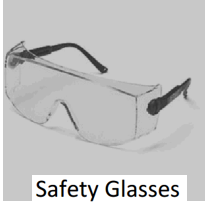
A pair of safety glasses (Source: RCTDS301_Drainage_system)
Respiratory Protection
Masks or respirators prevent inhalation of dust, fine fibers, and fumes that arise during processes like sanding leather or spraying finishes on accessories. SACCO-run workshops that produce leather belts and wallets often require respirators to protect workers from inhaling harmful particles.
Foot Protection
Closed-toe shoes or safety boots protect feet from sharp objects dropped on the floor and accidental punctures from pins or needles. In retail production units, where materials are stored on the floor, foot protection reduces injury risk and enhances worker confidence.
Hearing Protection
Though less common, hearing protection such as earplugs may be necessary in workshops using noisy machinery like industrial sewing machines or cutting equipment. For example, a hotel-based accessory production unit using automated cutting tools may require hearing protection to prevent long-term auditory damage.
Practice Questions
- Explain the importance of different types of PPEs in fashion accessory construction and provide examples of hazards they protect against. (10 marks)
- Identify and describe four types of PPEs used in a fashion design workshop. (8 marks)
- Discuss the role of respiratory protection in accessory making processes involving chemical use. (7 marks)
The rest of this chapter
🔒Create a free account to open more of this chapter.
Free: practical guides, quick cards, workplace scenarios and more.
Create a free account 🔒1.3 Apron
Aprons serve as a fundamental protective garment in fashion accessory construction, shielding clothing and skin from stains, sharp tools, and chemical exposure. Their use is widespread across Kenyan fashion studios, training institutions, and production units,…
🔒1.4 Dust coat
In Kenya's fashion industry, dust coats serve both functional and stylistic roles. They protect garments during storage and transport, maintaining the integrity of high-value fashion pieces designed in studios or boutiques. For fashion designers, especially th…
🔒1.5 Face mask
The use of face masks has become integral in Kenya's fashion industry, not only for health reasons but also as a fashion accessory that complements garment collections. Designers integrate face masks into their accessory lines to meet client demand for functio…
🔒1.6 Thimble
In the Kenyan fashion design industry, particularly for bespoke tailoring and couture work, the thimble is an essential tool in the construction of fashion accessories and garments. It protects the finger during hand sewing operations, allowing designers and a…
🔒1.7 Gloves
Gloves are a versatile fashion accessory with both functional and aesthetic roles in Kenyan fashion design. They serve as protective wear and style statements, often crafted from diverse materials such as leather, knit, or synthetic fabrics. In Kenya’s fashion…
🔒1.8 Low Heeled Closed Shoes
Low heeled closed shoes are an essential category of footwear in fashion accessories, especially for professional and formal settings in Kenya. These shoes combine practicality with style, offering comfort for long hours of wear while maintaining a polished ap…
🔒1.9 Use, Care and Storage of PPE’s
Personal Protective Equipment (PPE) is vital in the fashion industry, especially during the construction and finishing stages of fashion accessories. PPE protects designers, tailors, and production workers from hazards such as sharp tools, chemicals, and dust.…
🔒1.10 Fashion accessories tools and equipment
In the Kenyan fashion design industry, the construction of high-quality fashion accessories requires specialized tools and equipment that ensure precision, efficiency, and creativity. Designers and artisans in Nairobi, Mombasa, and Kisumu rely on these instrum…
🔒1.11 Tools
In fashion accessories construction, the selection and mastery of specific tools are critical for turning design concepts into tangible products. Kenyan fashion professionals working in urban and rural settings must understand not only the function of each too…
🔒1.12 Measuring
Measuring is a fundamental stage in planning fashion accessories construction. Accurate measurements ensure that accessories such as belts, hats, bags, and jewelry fit perfectly or complement the intended garment. In Kenya’s fashion industry, where bespoke tai…
🔒1.13 Finishing
Finishing in fashion accessories construction refers to the final processes that enhance the appearance, durability, and functionality of the accessory. In Kenya’s vibrant fashion sector, finishing techniques distinguish high-end accessories from mass-produced…
🔒1.14 Basic sewing
In the Kenyan fashion design industry, mastering basic sewing skills is essential for creating high-quality fashion accessories that meet client expectations and market demands. Whether working in a boutique in Nairobi or supplying accessories to retail outlet…
🔒1.15 Cutting tools and equipment
In fashion accessory design, precision in cutting fabric and materials directly affects the quality and fit of the final product. Kenyan designers and manufacturers rely on a variety of cutting tools and equipment to handle different materials ranging from tex…
🔒1.16 Marking
Marking is a foundational step in fashion accessories construction that involves transferring design details and measurements onto fabric or other materials. In Kenya’s competitive fashion industry, precise marking ensures that accessory components such as bel…
🔒1.17 Drawing
Drawing in fashion accessories construction is the visual representation of design ideas, technical details, and construction instructions. In Kenya’s dynamic fashion sector, clear and detailed drawings facilitate communication between designers, manufacturers…
🔒1.18 Equipment
In fashion accessories construction, the choice and use of appropriate equipment are fundamental to achieving precision, quality, and efficiency. In Kenya's dynamic fashion industry, from Nairobi boutiques to artisan cooperatives in Kisumu, having the right to…
🔒1.19 Display Equipment
Presenting fashion accessories effectively requires specialized display equipment that highlights product features and attracts customer interest. In Kenya’s retail sector, from high-end boutiques in Nairobi to artisanal markets in Mombasa, well-chosen display…
🔒1.20 Camera
In the Kenyan fashion design industry, a camera is an essential tool for documenting fashion accessories during the design and construction process. High-quality images support portfolio development, marketing, and client presentations. Fashion designers in Na…
🔒1.21 Sewing Machine
The sewing machine is a fundamental tool in fashion accessories construction for Kenyan designers, enabling precise assembly of materials such as leather, fabric, and synthetic components. Whether producing belts, bags, or decorative trims, mastery of sewing m…
🔒1.22 Fashion accessories materials and supplies
In Kenya’s vibrant fashion industry, the choice of materials and supplies for fashion accessories is critical to achieving both aesthetic appeal and functional durability. Designers must understand the wide variety of available materials and their properties t…
🔒1.23 Materials
Materials form the foundation of fashion accessories and significantly determine the quality, appearance, and usability of the final product. In Kenya’s fashion industry, designers must be adept at selecting and working with diverse materials suited to local c…
🔒1.24 Belts, bows and shoes
In the Kenyan fashion industry, accessories such as belts, bows and shoes are crucial finishing elements that enhance the overall garment design and wearer’s style. These accessories not only serve functional purposes but also communicate personal and cultural…
🔒1.25 Buttons
Buttons are essential fasteners and decorative elements in fashion design, playing a significant role in garment functionality and style. In Kenya’s diverse fashion market, buttons range from practical closures to statement pieces that reflect cultural identit…
🔒1.26 Embroidery Threads
Embroidery threads are essential materials in fashion accessories construction, providing texture, color, and design detail that can elevate a garment or accessory’s aesthetic appeal. In Kenya’s fashion industry, where vibrant and intricate designs are highly…
🔒1.27 Beads
Beads are fundamental embellishments in fashion accessories, offering texture, color, and cultural expression. In Kenya, beadwork has deep roots in traditional crafts and continues to inspire contemporary fashion designers who integrate beads into accessories…
🔒1.28 Brown Papers
Brown paper is a versatile material widely used in the construction and planning of fashion accessories within Kenya's dynamic fashion industry. From pattern making to packaging prototypes, brown paper offers affordability and functionality that align well wit…
🔒1.29 Charcoal
Charcoal is a traditional yet highly effective tool in fashion accessory design, primarily used for marking and sketching during the planning and construction phases. In Kenya, charcoal remains popular among fashion designers for its affordability, ease of use…
🔒1.30 Coloured pencils
Coloured pencils are an essential tool in the fashion accessories design process, especially in Kenya’s dynamic fashion industry where detailed sketches and vibrant presentations are vital. These pencils allow designers to create precise, colorful renderings o…
🔒1.31 Crayons
Crayons are a versatile and accessible medium used in fashion accessory design, particularly in the conceptual and early development phases of accessory creation in Kenya. Their ease of use, affordability, and broad color range make them popular among emerging…
🔒1.32 Dress Maker’s Pins
Understanding the various types of dressmaker’s pins is essential for their effective application in fashion accessory construction. Each type is designed to suit specific fabric types and garment sections. - Standard Steel Pins: These are the most common pins…
🔒1.33 Dressmakers Tracing Paper
Tracing paper is a fundamental tool in Kenyan fashion design studios for transferring pattern markings accurately onto fabric, a critical step in producing well-fitted accessories. Its use supports precision in cutting and sewing, particularly when working wit…
🔒1.34 Elastic
In fashion accessories construction, elastic plays a crucial role as a functional and aesthetic component. Kenyan fashion designers often incorporate elastic in accessories such as waistbands, headbands, belts, and cuffs to provide flexibility, comfort, and fi…
🔒1.35 Supplies
Fashion accessory construction depends heavily on the availability and quality of supplies such as threads, fasteners, fabrics, and decorative materials. In Kenya, sourcing reliable supplies can be challenging due to market variability and import costs, yet th…
🔒1.36 Fabrics
In fashion accessories design, selecting the appropriate fabrics is a foundational step that influences both the aesthetic appeal and functional performance of the final product. In Kenya’s vibrant fashion industry, where accessories range from handbags to hat…
🔒1.37 Inter lining
Inter lining is a critical component in fashion accessories construction, providing structure, support, and enhancing durability while influencing the accessory’s look and feel. In Kenya, where fashion accessories range from formal belts to casual bags, the ch…
🔒1.38 Interfacing
Interfacing is a crucial component in fashion accessories construction, especially in the Kenyan fashion industry where quality and durability are highly valued. It provides structure, support, and shape to accessories such as bags, belts, collars, and cuffs.…
🔒1.39 Lace
Lace is a decorative textile that significantly enhances the aesthetic appeal of fashion accessories. In Kenya’s fashion scene, lace is often employed in accessories such as gloves, headbands, collars, and bridal veils, symbolizing elegance and craftsmanship.…
🔒1.40 Lining
In fashion accessories design and production in Kenya, lining plays a critical role in enhancing the durability, aesthetics, and comfort of items such as bags, hats, belts, and gloves. Skilled fashion designers and artisans in Nairobi or Mombasa rely on approp…
🔒1.41 Ribbons
In the Kenyan fashion accessories sector, ribbons are versatile elements used for decoration, fastening, or structural enhancement. From embellishing hair accessories and hats to functional ties on bags and clothing accents, ribbons offer designers creative op…
🔒1.42 Sewing threads
In the Kenyan fashion design industry, the choice of sewing thread is a critical aspect of fashion accessories construction. Sewing threads not only hold fabric pieces together but also influence the durability, aesthetic appeal, and functionality of the finis…
🔒1.43 Stiffeners
In the construction of fashion accessories, stiffeners play an essential role in providing structure, shape, and support. In Kenya’s fashion industry, where accessories range from structured handbags to elegant hats, the choice and application of stiffeners di…
🔒1.44 Underlining
Underlining is a critical technique in fashion accessories construction that involves adding an additional layer of fabric beneath the main material to enhance durability, shape, and comfort. In the Kenyan fashion industry, where accessories like hats, belts,…
🔒1.45 Sketch Fashion Accessories
Sketching is more than just drawing; it is a foundational step that guides the entire accessory creation process. Kenyan fashion professionals rely on sketching for several critical reasons. - Idea Visualization: Sketches allow designers to rapidly capture and…
🔒1.46 Examples of fashion accessories
Fashion accessories are essential elements that complement and enhance the overall appearance of an outfit, providing both functional and aesthetic value. In the Kenyan fashion industry, accessories play a crucial role in defining personal style and cultural i…
🔒1.47 Hats
Hats are a prominent fashion accessory that not only serve practical purposes but also convey cultural, social, and stylistic messages. In Kenyan fashion, hats range from traditional headgear to contemporary designs, worn in urban and rural settings alike. For…
🔒1.48 Scarves
Scarves are versatile fashion accessories widely used in Kenya for both functional and aesthetic purposes. In the Kenyan fashion industry, scarves serve as statement pieces that complement traditional and contemporary outfits, especially in urban centers like…
🔒1.49 Bonnets
Bonnets are protective and decorative head coverings that hold cultural significance and practical value in Kenya’s fashion landscape. They are commonly used by women to protect hair from environmental damage, especially during sleep or while performing househ…
🔒1.50 Hoods
Hoods are versatile fashion accessories widely used in Kenyan apparel for both functional and stylistic purposes. In the fashion design industry, hoods enhance outerwear such as jackets and sweatshirts, providing protection from the elements while contributing…
🔒1.51 Headbands
Headbands serve as both functional and decorative accessories in Kenyan fashion, often used to manage hair and complement outfits. In the Kenyan fashion industry, headbands range from simple elastic bands to elaborate fabric or beaded designs reflecting cultur…
🔒1.52 Cravats
Cravats are a classic fashion accessory that add sophistication and flair to men’s and women’s formal or semi-formal attire. In Kenya’s fashion industry, cravats are often used to complement bespoke suits and dresses in corporate settings, upscale events, or c…
🔒1.53 Belts
Belts are essential fashion accessories that serve both functional and decorative purposes in apparel design. In Kenya, belts are widely used across various fashion segments, from casual wear in retail outlets to traditional attire at cultural festivals. The p…
🔒1.54 Bow
In Kenyan fashion design, bows serve as a classic and versatile accessory element, enhancing the aesthetic appeal of garments and complementing various styles. Whether applied as decorative motifs on dresses, blouses, or headwear, bows reflect both traditional…
🔒1.55 Shoes
Shoes are a fundamental fashion accessory that merges functionality with style, critical in completing any outfit. In Kenya, shoe design reflects a blend of traditional craftsmanship and modern fashion trends, with designers catering to diverse needs from casu…
🔒1.56 Bags
In Kenya's fashion industry, bags are essential accessories that blend functionality with style, reflecting both cultural influences and contemporary trends. Fashion designers must skillfully plan bag construction to meet diverse consumer needs, from everyday…
🔒1.57 Jewellery
Jewellery in Kenya holds cultural significance and contemporary fashion appeal, serving as a vital component of personal expression and identity. Fashion designers must approach jewellery construction with sensitivity to traditional motifs and modern aesthetic…
🔒1.58 Mats
Mats as fashion accessories have increasingly gained prominence in Kenya’s fashion industry, especially as designers seek to incorporate traditional weaving techniques and natural materials into contemporary designs. They serve not only functional purposes but…
Chapter Summary
This chapter covered the essential personal protective equipment (PPE) required in fashion accessories construction, detailing various types such as aprons, dust coats, face masks, thimbles, gloves, and low heeled closed shoes, along with their proper use, care, and storage. It then explored the key tools and equipment necessary for the craft, including measuring devices, finishing tools, basic sewing implements, cutting instruments, marking and drawing tools, and display equipment like cameras and sewing machines. The chapter also examined the wide range of materials and supplies used in making fashion accessories, from belts, bows, and buttons to embroidery threads, beads, and various papers and pencils for design purposes. Fabrics and supporting materials such as interlining, interfacing, lace, lining, ribbons, sewing threads, stiffeners, and underlining were described in terms of their roles in accessory construction. Finally, the chapter provided an overview of common fashion accessories, including hats, scarves, bonnets, hoods, headbands, cravats, belts, bows, shoes, bags, jewellery, and mats, emphasizing the importance of sketching and design in bringing these items to life. This comprehensive approach ensures a solid foundation for planning and executing fashion accessories construction effectively.
Self-Assessment
🔒 PDFDownload this self-assessment, with answers
A. Written Assessment
- Identify five types of Personal Protective Equipment (PPE) commonly used in fashion accessories construction and explain their specific purpose. (10 marks)
- Describe the proper care and storage methods for sewing gloves and explain why these practices are important. (5 marks)
🔒20 more in this section.
Chapter Examination Questions
🔒 PDFDownload these examination questions, with model answers
SECTION A (40 Marks) - Answer ALL Questions
- Identify five types of personal protective equipment (PPE) commonly used in fashion accessories construction and explain their specific purpose. (4 marks)
- Explain the role of an apron in protecting fashion designers during the construction process. (4 marks)
🔒18 more in this section.
Chapter Practical Activities
Practical 1: Construct a fashion apron 80cm x 90cm as per the provided working drawing
Fashion Design · Level 6
Fashion Accessories
PRACTICAL ASSESSMENT
TIME: 4 HOURS
⬇ PDFCandidate Instructions (Candidate Tool)
Type: Individual
INSTRUCTIONS TO CANDIDATE:
1. You are required to perform the following task:
i. Construct a functional apron measuring 80cm width by 90cm length with adjustable neck strap.
2. You have been provided with the following resources for the practical task:
| Tools & Equipment | Materials |
|---|
| Measuring tape | Lightweight cotton fabric |
| Tailor’s chalk or fabric marking pencil | Lining fabric |
| Fabric scissors | Sewing thread |
| Dressmaker’s pins | Adjustable apron neck strap buckle |
| Sewing machine | Brown pattern drafting paper |
| Iron and ironing board | Personal Protective Equipment |
| Hand sewing needle | |
⬇ PDFResources Required (Cutting List)
| S/N | Item | Quantity |
|---|
| 1 | Lightweight cotton fabric | 1 meter per Candidate |
| 2 | Lining fabric (lightweight, matching design fabric) | 0.5 meter per Candidate |
| 3 | Sewing thread (matching fabric) | 1 spool per Candidate |
| 4 | Adjustable apron neck strap buckle (plastic or metal, 3 cm length) | 1 Pc per Candidate |
| 5 | Brown pattern drafting paper | 1 sheet (A2 size) per Candidate |
| 6 | Tailor’s chalk or fabric marking pencil | 1 Pc per Candidate |
| 7 | Dressmaker’s pins | 1 box per 5 Candidates |
| 8 | Measuring tape | 1 Pc per Candidate |
| 9 | Fabric scissors | 1 Pc per Candidate |
| 10 | Sewing machine | 1 Pc per Candidate |
| 11 | Iron and ironing board | 1 set per Candidate |
| 12 | Personal Protective Equipment (dust coat, thimble, flat closed shoes) | 1 set per Candidate |
| 13 | Hand sewing needle | 1 Pc per Candidate |
| 14 | Work table or cutting surface | 1 per Candidate |
⬇ PDFAssessor Guide
| Items to be Evaluated | Marks Available | Marks Obtained | Comments |
|---|
| TASK 1: Preparation and Safety |
Wore all required personal protective equipment (dust coat, thimble, flat closed shoes)
(Award 1 mark for each item worn correctly) | 3 | | |
Observed occupational safety and health requirements (well-lit working area, well-ventilated room)
(Award 1 mark for each condition met) | 2 | | |
| Sub-Total | 5 | | |
| TASK 2: Tools, Materials Identification and Pattern Development |
Identified and gathered all required tools, materials and supplies as per standard operating procedures
(Award 1 mark for each category identified: fabric, thread, buckle, cutting tools, PPE) | 5 | | |
Developed apron pattern pieces based on the design sketch: front panel, back panel, neck strap, waist ties
(Award 1.5 marks for each correctly developed pattern piece) | 6 | | |
Added appropriate pattern instructions on each drafted pattern piece (grain line, number of pieces, seam allowance, pattern name, notches/balance marks)
(Award 0.5 marks for each instruction correctly added) | 4 | | |
| Sub-Total | 15 | | |
| TASK 3: Laying, Cutting and Marking |
Laid apron pattern pieces on fabric in accordance with fabric grain and pattern instructions
(Award 1 mark for each correctly laid pattern piece: front, back, neck strap, ties) | 4 | | |
Cut apron fabric pieces neatly with long smooth strokes
(Award 1.5 marks for each correctly cut piece) | 6 | | |
Transferred all pattern markings to fabric pieces accurately (notches, balance marks, seam lines)
(Award 1 mark for each marking type transferred) | 3 | | |
| Sub-Total | 13 | | |
| TASK 4: Sewing Machine Preparation and Construction |
Checked sewing machine for serviceability (correct threading of bobbin and upper thread, fixed needle, adjusted stitch length and tension, tested stitches)
(Award 1 mark for each correct step) | 5 | | |
Joined apron pieces as per design using straight stitchery (joined front and back panels, attached neck strap with adjustable buckle, attached waist ties)
(Award 2 marks for each correctly sewn assembly step) | 10 | | |
Neatened raw edges appropriately to prevent fraying
(Award 2 marks if done correctly) | 2 | | |
| Sub-Total | 17 | | |
| TASK 5: Finishing and Presentation |
Removed all temporary stitches, pins and hanging threads
(Award 2 marks if done correctly) | 2 | | |
Pressed apron neatly to remove creases and set seams
(Award 2 marks if done correctly) | 2 | | |
Displayed apron on provided display space as per standard procedure
(Award 2 marks if done correctly) | 2 | | |
| Sub-Total | 6 | | |
| PRODUCT CHECKLIST |
Apron dimensions within +/- 1 cm tolerance (Width 80 cm, Length 90 cm)
(Award 2 marks for each correct dimension) | 4 | | |
Neck strap correctly positioned, securely attached and adjustable with buckle
(Award 4 marks if all criteria met) | 4 | | |
Waist ties attached symmetrically and securely
(Award 3 marks if done correctly) | 3 | | |
Seams straight, even, and raw edges concealed or neatened
(Award 1 mark for each seam quality attribute) | 5 | | |
Overall presentation: clean, well pressed, no hanging threads, correct style according to sketch
(Award 1 mark for each presentation attribute) | 4 | | |
| Sub-Total | 20 | | |
| GRAND TOTAL | 76 | | |
ASSESSMENT OUTCOME: ☐ Competent ☐ Not Yet Competent (competent if at least 50%)
Practical 2: Sew a functional face mask 20cm x 15cm
Fashion Design · Level 6
Fashion Accessories
PRACTICAL ASSESSMENT
TIME: 4 HOURS
⬇ PDFCandidate Instructions (Candidate Tool)
Type: Individual
INSTRUCTIONS TO CANDIDATE:
1. You are required to perform the following task:
i. Sew a functional face mask measuring 20cm by 15cm.
2. You have been provided with the following resources for the practical task:
| Tools & Equipment | Materials |
|---|
| Sewing machine | Light weight cotton fabric |
| Measuring tape | Elastic band (0.5cm width) |
| Tailor's chalk | White sewing thread |
| Fabric scissors | Brown paper |
| Hand sewing needles | Personal protective equipment |
| Iron and ironing board | |
| Pattern drafting tools | |
⬇ PDFResources Required (Cutting List)
| S/N | Item | Quantity |
|---|
| 1 | Light weight cotton fabric | 75cm by 75cm per Candidate |
| 2 | Elastic band (0.5cm width) | 60cm per Candidate |
| 3 | White sewing thread | 1 spool per Candidate |
| 4 | Brown paper | 1 sheet per Candidate |
| 5 | Personal protective equipment (dust coat, flat closed shoes) | 1 set per Candidate |
| 6 | Sewing machine | 1 per Candidate |
| 7 | Measuring tape | 1 per Candidate |
| 8 | Tailor's chalk | 1 per Candidate |
| 9 | Fabric scissors | 1 per Candidate |
| 10 | Hand sewing needles | 1 per Candidate |
| 11 | Iron and ironing board | 1 per Candidate |
| 12 | Pattern drafting tools (rulers, French curve, pencils) | 1 set per Candidate |
⬇ PDFAssessor Guide
| Items to be Evaluated | Marks Available | Marks Obtained | Comments |
|---|
| TASK 1: Preparation and Safety |
Wore personal protective equipment (dust coat, flat closed shoes)
(Award 1 mark each) | 2 | | |
Ensured working area is well-lit and well-ventilated
(Award 1 mark each) | 2 | | |
Identified and gathered required tools, equipment and materials
(Award 1 mark each for tools, materials, and equipment) | 3 | | |
| Sub-Total | 7 | | |
| TASK 2: Pattern Development and Cutting |
Drafted face mask pattern pieces on brown paper: front piece and lining piece
(Award 2 marks each pattern piece) | 4 | | |
Added pattern instructions: grain line, number of pieces to cut, seam allowances, pattern name
(Award 1 mark each) | 4 | | |
Laid pattern pieces on fabric following grain line and layout instructions
(Award 1 mark each for correct layout of front and lining pieces) | 2 | | |
Cut fabric pieces using fabric scissors with clean, long strokes
(Award 1 mark each for front and lining pieces) | 2 | | |
Transferred pattern markings accurately to fabric pieces (seam allowance, notches)
(Award 1 mark each for seam allowance and notches) | 2 | | |
| Sub-Total | 14 | | |
| TASK 3: Machine Serviceability and Stitching |
Checked sewing machine serviceability: threaded bobbin and upper thread correctly, fixed needle properly
(Award 1 mark each) | 3 | | |
Adjusted stitch length and tension, tested stitches and made adjustments
(Award 2 marks total) | 2 | | |
Sewn face mask pieces correctly following the design and standard sewing procedures
(Award 3 marks each for assembling front and attaching elastic) | 6 | | |
| Sub-Total | 11 | | |
| TASK 4: Finishing and Presentation |
Removed temporary stitches, pins, and trimmed hanging threads
(Award 2 marks total) | 2 | | |
Pressed the finished face mask neatly
(Award 2 marks total) | 2 | | |
Displayed the face mask properly with correct labeling
(Award 2 marks total) | 2 | | |
| Sub-Total | 6 | | |
| PRODUCT CHECKLIST |
Face mask dimensions within +/- 1 cm: 20cm length, 15cm width
(Award 2 marks each for length and width) | 4 | | |
Elastic bands attached securely and correctly sized
(Award 2 marks each for security and size) | 4 | | |
Seams are straight, neat and raw edges well concealed
(Award 5 marks total) | 5 | | |
Face mask functional: fits face shape, elastic allows comfortable wearing
(Award 5 marks total) | 5 | | |
Presentation: no hanging threads, clean, well pressed, correct style
(Award 1 mark each) | 5 | | |
| Sub-Total | 23 | | |
| GRAND TOTAL | 61 | | |
ASSESSMENT OUTCOME: ☐ Competent ☐ Not Yet Competent (competent if at least 50%)
🔒Prepare and maintain a thimble for sewing usePractical 3
🔒Select and Use Gloves and Low Heeled Closed Shoes as PPEPractical 4
🔒Set out fashion accessory patterns using measuring and marking toolsPractical 5
🔒Operate cutting tools to prepare fashion accessory materialsPractical 6
🔒Apply finishing techniques using appropriate tools on a leather wristwatch strap 22mm wide and 250mm longPractical 7
🔒Sew a fashion accessory pouch 25cm x 15cm using a sewing machinePractical 8
🔒Prepare and use display equipment for fashion accessories photographyPractical 9
🔒Select and Prepare Materials for Fashion Accessories: Belts, Bows, and ShoesPractical 10
🔒Prepare and use pattern drafting supplies for accessory patternsPractical 11
🔒Sketch Various Fashion AccessoriesPractical 12