Calibrating textile equipment is a critical aspect of quality control in fashion design, ensuring that machinery used in fabric cutting, measuring, and finishing operates accurately and consistently. In Kenya's competitive fashion industry, where precision affects both product quality and customer satisfaction, proper calibration reduces material wastage and enhances production efficiency. Professionals working in garment factories, tailoring workshops, and textile manufacturing units must understand safety requirements, including the use of personal protective equipment (PPE), to maintain safe working environments during calibration processes. This chapter focuses on the selection and use of PPEs, with particular attention to aprons, which are essential for protecting workers from hazards during equipment handling.
1.1 PPEs
Personal Protective Equipment (PPE) is vital for safeguarding fashion design professionals during textile equipment calibration. In Kenyan textile workshops, where workers may encounter sharp tools, moving parts, and chemical agents, PPE minimizes injury risks and ensures compliance with occupational safety standards. Understanding the types of PPE and the factors influencing their selection helps maintain a safe and productive workspace.
1.1.1 Types of PPEs
PPEs come in various forms tailored to protect different parts of the body from specific hazards encountered during textile equipment calibration. Each type addresses unique risks associated with the operation of cutting machines, pressing equipment, and fabric handling.
Hand Protection
Gloves are crucial for protecting hands from cuts, abrasion, and chemical exposure. In garment factories such as those in Nairobi's industrial areas, anti-cut gloves made of Kevlar or reinforced fabrics prevent injuries from sharp blades and needles. Chemical-resistant gloves are used when handling dyes or cleaning agents.
Eye Protection
Safety goggles or face shields guard against flying debris, dust, and chemical splashes. For example, workers operating fabric cutting machines in textile workshops in Mombasa wear goggles to prevent injury from fabric fibers and small fragments.
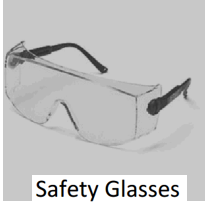
A pair of safety glasses (Source: RCTDS301_Drainage_system)
Respiratory Protection
Dust masks or respirators protect workers from inhaling textile dust and chemical fumes, which are common in fabric treatment and dyeing sections. Employees at a textile finishing unit in Kisumu use respirators to avoid respiratory problems caused by prolonged exposure to airborne particles.
Foot Protection
Safety boots with reinforced toes protect feet from heavy falling objects or accidental impacts during equipment maintenance. In tailoring workshops in Nakuru, steel-toed boots are standard to prevent foot injuries from dropped tools or fabric rolls.
Hearing Protection
Earplugs or earmuffs reduce noise exposure from loud machinery such as industrial sewing machines and pressing equipment. Workers in large-scale garment production facilities in Eldoret use hearing protection to prevent long-term hearing damage.
1.1.2 Factors to Consider When Selecting PPEs
Selecting appropriate PPE for textile equipment calibration involves evaluating multiple factors to ensure effectiveness, comfort, and compliance with safety regulations. These considerations help fashion design professionals maintain safety without compromising productivity.
Hazard Identification
The first step is identifying specific hazards present during calibration, such as sharp blades, chemical exposure, or airborne particles. For instance, a quality control technician at a textile manufacturing company in Thika must assess risks before choosing gloves or masks.
Material Compatibility
PPE materials must be compatible with the hazards they protect against. Chemical-resistant gloves, for example, should be selected based on the type of chemicals used in fabric treatment to prevent degradation and ensure safety.
Comfort and Fit
Comfort influences PPE compliance. Ill-fitting gloves or tight goggles can reduce dexterity and cause discomfort, leading to improper use. Tailors in boutique workshops in Nairobi prefer lightweight, breathable PPE that allows ease of movement during calibration.
Durability and Maintenance
PPE should withstand repeated use and be easy to clean or replace. Durable aprons and gloves reduce replacement costs and maintain consistent protection in busy production environments such as those found in garment factories in Thika.
Compliance with Standards
PPE must meet local and international safety standards, such as those set by the Kenya Bureau of Standards (KEBS) and the Occupational Safety and Health Act (OSHA) of Kenya. Ensuring compliance protects workers and reduces liability for employers.
The rest of this chapter
🔒Create a free account to open more of this chapter.
Free: practical guides, quick cards, workplace scenarios and more.
Create a free account 🔒1.3 Apron
Aprons are an essential component of PPE in fashion design workshops, particularly during textile equipment calibration where fabric dust, dyes, and sharp tools pose risks. The apron protects clothing and skin, maintaining hygiene and safety standards required…
🔒1.4 Dust Coat
In the Kenyan fashion design industry, maintaining a clean and contaminant-free environment is crucial during textile equipment calibration. A dust coat serves as protective clothing that shields both the operator and the fabric from dust particles, lint, and…
🔒1.5 Face Mask
In the context of textile equipment calibration and handling within Kenyan fashion design environments, the face mask is an essential personal protective equipment item. It protects both the operator and the textile samples by minimizing contamination from res…
🔒1.6 Safety Shoes
In the Kenyan fashion design industry, especially within textile manufacturing and quality control environments, safety shoes are an essential component of personal protective equipment. Employees working around heavy machinery, cutting tools, or handling bulk…
🔒1.7 Gloves
In fashion design production, especially during textile handling, cutting, and quality control, gloves are vital for protecting workers’ hands from injuries, contamination, and chemical exposure. In Kenya’s garment factories and tailoring workshops, where prec…
🔒1.8 Eye Glasses
In the Kenyan fashion design industry, precision in colour matching and detail inspection is critical. Textile professionals often rely on optical aids such as eye glasses to enhance visual acuity during quality control and equipment calibration. Eye glasses n…
🔒1.9 Overalls
Overalls are an essential component of personal protective equipment (PPE) in Kenyan textile and fashion design environments. They provide practical protection against fabric dust, dyes, and mechanical hazards during garment production and equipment calibratio…
🔒1.11 Preparation of Calibration Checklist
Calibration of textile equipment in fashion design is a critical process that ensures machines operate within specified tolerances, producing consistent and quality fabrics and garments. In Kenya's vibrant textile and apparel sector, where competitive quality…
🔒1.12 Definition of the Term Calibration
Calibration is a fundamental concept in quality control for fashion design, especially in textile manufacturing where precision directly influences garment fit and fabric consistency. In Kenya's fashion industry, calibration ensures that textile equipment such…
🔒1.13 Elements of a calibration checklist
Calibration checklists are essential tools in the quality control process for textile equipment, ensuring precision and reliability in measurements critical to fashion design production. In the Kenyan textile industry, where accuracy directly affects fabric qu…
🔒1.14 Instrument details
Accurate information about the instruments used in fashion design textile quality control is vital for effective calibration and maintenance. In Kenya’s competitive fashion industry, understanding instrument details ensures that operators can perform precise m…
🔒1.15 Calibration Standards
Calibration standards form the benchmark for accuracy and consistency in measuring textile equipment performance in the fashion design industry. In Kenya, where textile and garment manufacturing plays a vital role in the economy, adherence to calibration stand…
🔒1.16 Calibration Procedure
Calibration procedures provide a systematic approach to verifying and adjusting textile equipment to ensure measurement accuracy. In Kenya’s fashion design industry, following a clear calibration procedure reduces defects, limits wastage of costly fabrics, and…
🔒1.17 Records
In the Kenyan fashion design industry, maintaining accurate and detailed records during textile equipment calibration is essential for ensuring quality control and traceability. Proper documentation enables fashion houses, garment manufacturers, and textile su…
🔒1.18 Calibration Materials
Calibration materials are fundamental in ensuring the accuracy and reliability of textile equipment used in fashion design and production. These materials serve as reference standards or tools against which equipment is tested and adjusted. In Kenya, where loc…
🔒1.19 Textile fibres
Textile fibres are the fundamental raw materials in fashion design and garment production. In Kenya's vibrant textile and apparel industry, understanding the properties and types of fibres is crucial for quality control and ensuring that finished products meet…
🔒1.20 Yarns
Yarns are continuous strands of fibres twisted or spun together and are the building blocks of fabrics. In Kenya’s textile and fashion industry, yarn quality directly affects fabric performance, appearance, and ultimately the quality of garments produced. Unde…
🔒1.21 Reagents
In the Kenyan fashion design industry, particularly in textile quality control, reagents play a crucial role in assessing fabric properties and ensuring that materials meet required standards. Reagents are chemical substances used to detect, measure, or analyz…
🔒1.22 Calibration Tools and Equipment
Calibration tools and equipment are vital in ensuring that textile testing instruments provide precise and consistent results. In Kenya’s fashion design industry, where fabric quality directly affects garment durability and customer satisfaction, regular calib…
🔒1.23 Types of tools and equipment
In the Kenyan fashion design industry, precision and quality assurance depend heavily on using the right tools and equipment. Textile calibration demands a variety of specialized instruments to measure fabric properties accurately, ensuring garments meet desig…
🔒1.24 Spanners
Spanners are fundamental hand tools in the calibration and maintenance of textile equipment, widely used in Kenya’s fashion manufacturing industry. Their role in tightening, loosening, and adjusting nuts and bolts is critical for ensuring machine components re…
🔒1.25 Tweezers
Tweezers are essential precision tools in fashion design quality control, particularly useful when handling small textile components such as threads, beads, or fabric fibers. In Kenya's garment manufacturing and tailoring sectors, tweezers facilitate detailed…
🔒1.26 Screwdriver
Screwdrivers come in various head types and sizes, each designed for specific screw profiles found in textile equipment. Efficient use of screwdrivers ensures that textile machines are adjusted accurately without damaging screws or equipment components. - Matc…
🔒1.27 Yarn Count Machine
In the Kenyan fashion industry, precise yarn measurement is vital for ensuring fabric quality and consistency in garment production. A yarn count machine plays a crucial role in textile quality control by accurately determining the yarn count, which affects fa…
🔒1.28 Microscope
Microscopes used in textile quality control vary in complexity and purpose, each suited to specific inspection needs. - Optical microscopes: Utilize visible light to magnify textile fibers and yarns, suitable for routine quality checks in garment factories. -…
🔒1.29 Calibration standards
Calibration standards are fundamental benchmarks used to verify and adjust the accuracy of textile equipment in the fashion design industry. In Kenya, where quality assurance is increasingly critical for both local garment producers and exporters, adhering to…
🔒1.30 Define the term calibration standards
Calibration standards refer to the documented and certified benchmarks or reference materials used to check, adjust, and validate the accuracy of measuring instruments and equipment. In the context of textile manufacturing and fashion design in Kenya, these st…
🔒1.31 Types of calibration standards
In the Kenyan fashion design industry, precise calibration of textile equipment is essential to maintain product quality and consistency. Calibration standards serve as benchmarks to ensure that instruments used in measuring fabric properties, colour, and othe…
🔒1.32 Colour
Colour calibration is critical in fashion design to ensure that fabric hues and garment shades match design specifications and consumer expectations. Accurate colour measurement and control reduce costly errors such as dye lot mismatches and ensure consistency…
🔒1.33 Length
Length measurement is a fundamental aspect of textile quality control in fashion design. Accurate length calibration ensures that fabric cuts, trims, and garment dimensions match design specifications, preventing wastage and ensuring customer satisfaction. In…
🔒1.34 Yarn Count
Yarn count is a critical parameter in textile manufacturing that defines the fineness or thickness of yarn used in fabric production. In Kenya’s fashion industry, yarn count influences fabric texture, strength, and garment quality, impacting design choices and…
🔒1.35 Weight
In the context of fashion design in Kenya, accurately calibrating textile equipment for weight measurement is essential for maintaining fabric quality, cost control, and ensuring garment consistency. Weight directly influences fabric selection, pricing, and pr…
🔒1.36 Performance of Calibration
Calibration performance in textile equipment directly affects the reliability of measurements and the overall quality control process in fashion design. In Kenya’s dynamic garment manufacturing sector, where both small-scale tailors and large factories operate…
🔒1.37 Laboratory
In the context of fashion design in Kenya, textile laboratories play a crucial role in ensuring the quality and consistency of fabrics used in garment production. These controlled environments are equipped with specialized instruments that require regular cali…
🔒1.38 Receiving
In fashion design production, the receiving stage is critical for maintaining quality control as raw textile materials and components arrive at the facility. Proper calibration of equipment used during receiving ensures accurate inspection and verification of…
🔒1.39 Equipment Test Run
In the Kenyan fashion design industry, conducting an equipment test run is crucial to ensure textile machinery functions correctly before full-scale production. This process helps identify faults or misalignments that could compromise fabric quality, leading t…
🔒1.40 Initial Test Run
The initial test run in fashion design textile production in Kenya marks the first full operational trial of calibrated equipment using actual production materials. This phase validates that all adjustments made during calibration and the preliminary test run…
🔒1.41 Routine Test Run
Routine test runs are critical in fashion design for ensuring textile equipment consistently produces fabrics or garments that meet quality standards. In Kenya’s dynamic garment manufacturing sector, where firms like Nairobi-based textile workshops compete on…
🔒1.42 Trial Run
Trial runs are essential in the fashion design industry when introducing new textile equipment, materials, or production processes. They allow Kenyan manufacturers, such as those supplying Nairobi’s retail clothing outlets, to test and refine operations before…
🔒1.43 Failure Test Run
In the context of fashion design, particularly within Kenya’s vibrant textile and garment sector, a failure test run is a critical quality control process used to identify faults or inconsistencies in textile equipment before full-scale production begins. This…
🔒1.44 Calibration Report
A calibration report documents the results of testing and adjusting textile equipment to ensure it operates within specified tolerances. In Kenya’s fashion design industry, this report is essential for maintaining traceability, accountability, and continuous i…
🔒1.45 Report Title Identification
In the Kenyan fashion design industry, precise documentation of calibration activities is essential for maintaining quality standards and traceability. Calibration reports serve as official records that confirm textile equipment has been checked and adjusted t…
🔒1.46 Calibration Standards
Calibration standards are fundamental benchmarks that guide the adjustment and verification of textile equipment to ensure accurate measurements and consistent product quality. In Kenya’s fashion design sector, adherence to recognized calibration standards fos…
🔒1.47 Instrument Condition
Maintaining the proper condition of textile measuring instruments is critical for quality control in fashion design, particularly in Kenya’s competitive garment industry. Faulty or poorly maintained instruments can lead to inaccurate measurements, resulting in…
🔒1.48 Calibration Procedure
Calibration of textile equipment is a systematic process that ensures measuring instruments produce accurate and consistent results, which is fundamental in the Kenyan fashion design industry. Precision in fabric measurements, colour matching, and material tes…
🔒1.49 Calibration Results
Calibration results form a critical part of quality control in textile equipment used in fashion design. In Kenya's vibrant textile industry, where precision influences fabric quality and garment fit, accurate calibration data ensures that machines operate wit…
🔒1.50 House-keeping Activities
Maintaining a clean and organized workspace is essential in textile production and fashion design to ensure equipment longevity and product quality. In Kenyan garment factories and design studios, effective house-keeping contributes to safety, efficiency, and…
🔒1.52 Filling
In the context of textile equipment calibration within Kenyan fashion design, filling refers to the process of ensuring that the yarn or thread supply is correctly set and maintained during fabric production or testing. Filling directly influences the quality…
🔒1.53 Clearance of Work Station
Clearance of the work station in the context of fashion design textile equipment calibration refers to the systematic process of cleaning, organizing, and preparing the workspace before and after calibration tasks. In Kenyan fashion production environments, ma…
🔒1.54 Waste Disposal
In fashion design, especially within Kenya’s vibrant textile industry, managing waste disposal effectively is crucial for maintaining quality control and environmental compliance. Textile waste includes fabric offcuts, defective materials, packaging, and chemi…
🔒1.55 Stock Taking
Stock taking is a vital process in fashion design enterprises across Kenya, ensuring accurate inventory records for fabrics, trims, and finished goods. Effective stock management supports production planning, cost control, and quality assurance. For instance,…
Chapter Summary
This chapter covered the essential aspects of calibrating textile equipment, beginning with the identification and selection of appropriate personal protective equipment including aprons, dust coats, face masks, safety shoes, gloves, eye glasses, and overalls. It emphasized the factors to consider when choosing PPE to ensure safety during calibration activities. The preparation and components of a calibration checklist were detailed, highlighting instrument details, calibration standards, procedures, records, and necessary materials such as textile fibres, yarns, and reagents. Various calibration tools and equipment were described, including spanners, tweezers, screwdrivers, yarn count machines, and microscopes. The concept and types of calibration standards were explained with focus on attributes like colour, length, yarn count, and weight. The chapter also outlined the performance stages of calibration including laboratory setup, receiving, equipment test runs, and various test run types such as initial, routine, trial, and failure runs. Finally, the importance of producing a comprehensive calibration report and maintaining effective housekeeping activities such as filling, workstation clearance, waste disposal, and stock taking were discussed to ensure quality control in textile calibration processes.
Self-Assessment
🔒 PDFDownload this self-assessment, with answers
A. Written Assessment
- Identify five types of personal protective equipment (PPE) commonly used in textile calibration laboratories. (5 marks)
- Explain three factors to consider when selecting PPEs for use in a fashion design textile laboratory. (6 marks)
🔒20 more in this section.
Chapter Examination Questions
🔒 PDFDownload these examination questions, with model answers
SECTION A (40 Marks) - Answer ALL Questions
- Identify five types of personal protective equipment (PPE) commonly used in a textile quality control laboratory and explain their specific use in protecting workers. (4 marks)
- Explain two factors that should be considered when selecting PPE for textile equipment calibration in a Kenyan garment factory. (4 marks)
🔒28 more in this section.