What you will be able to do
By the end of this chapter, you will be able to:
- Wear the correct personal protective equipment for food handling safely and confidently.
- Prepare ingredients correctly and carefully according to the recipe.
- Produce specialized meals accurately by following the recipe and menu step-by-step.
- Manage and dispose of waste properly following workplace safety and hygiene procedures.
Mastering these skills helps you create delicious, safe meals that meet customer needs and keep the kitchen running smoothly!
Specialized meal preparation in nutrition and dietetics requires strict adherence to hygiene and safety standards to protect vulnerable clients and maintain food quality. In Kenya's healthcare and institutional settings, managing specialized diets for patients with conditions such as diabetes, renal disease, or allergies demands that food handlers use appropriate personal protective equipment (PPE). PPE not only prevents contamination but also safeguards the handler from exposure to potential hazards in the kitchen environment. This chapter focuses on the essential PPEs involved in specialized meal preparation, detailing their specifications, proper use, and maintenance.
4.1 PPEs for Food Handling
Food handlers working in hospitals, school feeding programs, or rehabilitation centres in Kenya must consistently use PPE to minimize contamination risks. PPE forms a critical barrier between the food and possible biological or physical contaminants introduced by the preparer. Each piece of PPE has a specific role in protecting both the food and the food handler, ensuring compliance with Kenya’s Food, Drugs and Chemical Substances Act and public health regulations.
4.1.1 Kitchen Gloves
Types of Kitchen Gloves
There are several types of kitchen gloves used in food handling, each suited to different tasks:
- Disposable Latex Gloves: Thin and flexible, ideal for short-term tasks requiring tactile sensitivity, such as portioning or handling delicate foods.
-
Nitrile Gloves: Resistant to chemicals and punctures, suitable for handling cleaning agents or tasks involving raw meat.
-
Vinyl Gloves: Cost-effective and latex-free, used where allergies are a concern but less durable than nitrile or latex.
-
Heat-Resistant Gloves: Made from materials like Kevlar, used when handling hot pots or trays to prevent burns.
-
Cut-Resistant Gloves: Worn when using sharp knives or slicers to reduce injury risk.
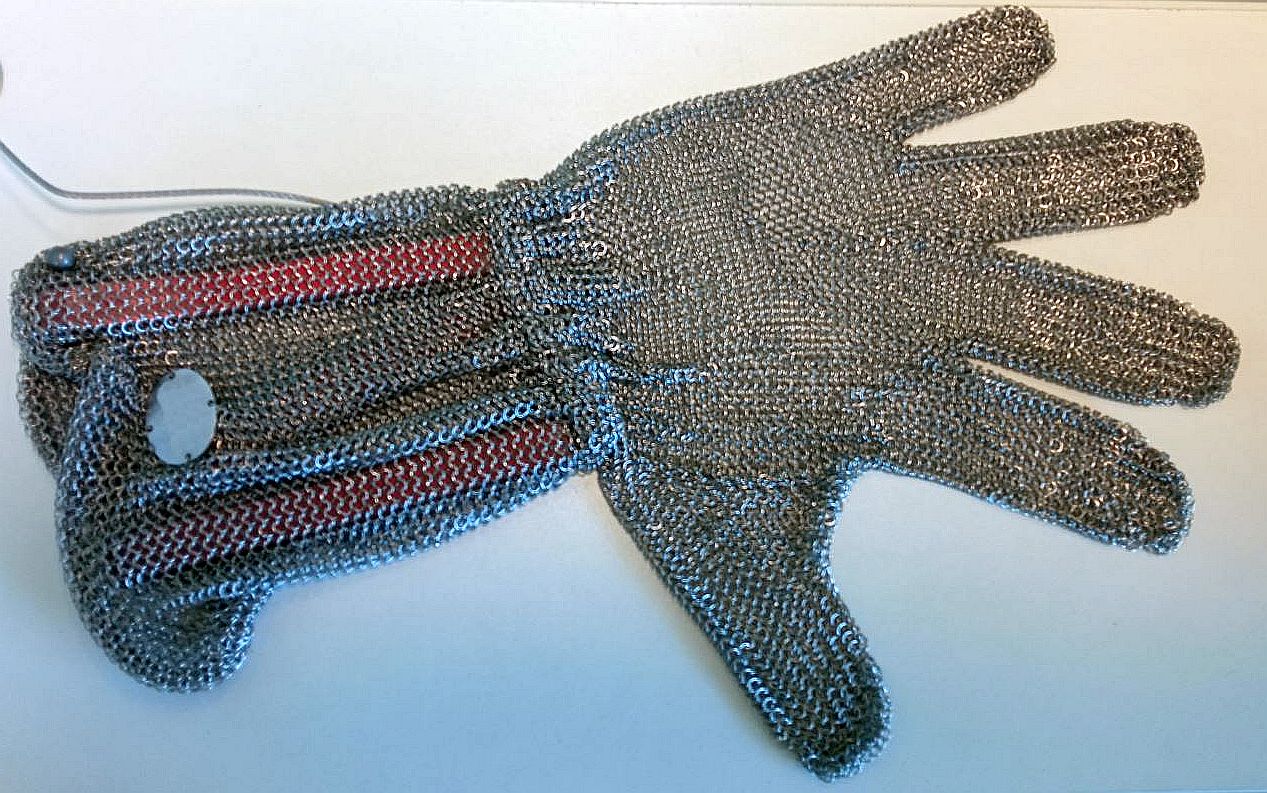
Metal mesh cut-resistant glove (Source: Wikimedia Commons)
Proper Use of Kitchen Gloves
Correct glove use is essential to maximize safety and hygiene:
- Always wash hands thoroughly before putting on gloves to prevent trapping contaminants.
- Change gloves frequently, especially when switching between tasks such as handling raw meat and ready-to-eat foods.
- Avoid touching non-food surfaces like phones or door handles while wearing gloves to prevent cross-contamination.
- Dispose of single-use gloves immediately after use; never reuse disposable gloves.
- Use gloves appropriate to the specific task, for example, heat-resistant gloves when handling hot equipment.
Maintenance and Disposal
Maintaining glove hygiene reduces contamination risks and protects the environment:
- Store gloves in a clean, dry place away from direct sunlight to prevent degradation.
- Inspect gloves for tears or punctures before use; discard damaged gloves immediately.
- Follow hospital or institutional protocols for disposal of contaminated gloves, often using biohazard waste bins.
- Encourage handwashing after glove removal to eliminate any contaminants on the skin.
- Promote use of powder-free gloves to minimize allergic reactions among staff and patients.
4.1.2 Hairnets and Caps
Hairnets and caps are vital PPE items that prevent hair and scalp contaminants from falling into food, maintaining the integrity of specialized meals for patients with strict dietary requirements.
Design and Materials
Hairnets and caps vary in design depending on comfort and coverage needs:
- Disposable Hairnets: Made from lightweight, breathable mesh fabric, these are single-use and prevent loose hair strands.
- Reusable Caps: Often made of cotton or polyester, washable and durable for repeated use in controlled environments.
- Full-Coverage Caps: Provide additional coverage for longer hair or beards, ensuring no hair escapes during food preparation.
- Elastic Band Hairnets: Secure fit around the head to prevent slipping during movement.
- Bouffant Caps: Large and loose-fitting, ideal for covering all hair, including buns and ponytails.
Importance in Specialized Meal Preparation
In clinical nutrition settings, contamination from hair can introduce pathogens or allergens into sensitive meals:
- Hair carries microbes that can cause foodborne illnesses, a significant risk for hospital patients with compromised immunity.
- Hairnets prevent physical contamination that might trigger allergic reactions, important in schools or rehabilitation centres.
- Caps provide a hygienic barrier, especially in open kitchen environments or when handling powdered supplements.
- They support compliance with Kenya Bureau of Standards (KEBS) hygiene guidelines for food service.
- Use of hairnets and caps reassures patients and regulatory bodies that food safety protocols are respected.
Proper Wearing and Maintenance
Ensuring hairnets and caps function effectively requires correct use:
- Hair should be fully enclosed within the net or cap before entering the kitchen.
- Disposable hairnets must be discarded after each shift or if soiled.
- Reusable caps should be laundered daily using hot water and detergent to remove oils and microbes.
- Avoid touching hair or adjusting caps during food handling to reduce contamination risks.
- Staff with facial hair should use beard nets or caps with extended coverage.
4.1.3 Aprons
Aprons protect the food handler’s clothing and reduce the transfer of contaminants to food during specialized meal preparation.
Types of Aprons
Different apron materials and designs suit various food handling environments:
- Disposable Plastic Aprons: Provide waterproof protection, ideal for wet or messy tasks such as washing vegetables or handling raw meat.
- Cotton or Polyester Aprons: Reusable and comfortable, common in clinical kitchens where durability is needed.
- Bib Aprons: Cover the chest and waist, providing extensive protection against spills.
- Sleeved Aprons: Include sleeves to protect arms, useful when handling hot liquids or cleaning agents.
- High-Visibility Aprons: Used in large institutional kitchens for safety and easy identification of food handlers.
Role in Food Safety
Aprons serve as a physical barrier to prevent contamination from clothing fibers, dust, or pathogens:
- Clothing can carry dust, dirt, or microorganisms from outside the kitchen; aprons shield food from these contaminants.
- Aprons reduce the risk of cross-contamination when moving between different food preparation areas.
- They protect the food handler’s uniform from spills that could cause slips or burns.
- Use of aprons aligns with Kenya’s public health standards for food hygiene in institutional catering.
- Aprons can be removed quickly if contaminated, preventing spread of contaminants.
Care and Maintenance
Proper cleaning and storage maintain apron effectiveness and hygiene:
- Reusable aprons must be washed daily with detergent at temperatures of at least 60°C to eliminate microbes.
- Aprons should be stored in clean, dry areas separate from personal clothing.
- Disposable aprons require immediate disposal after use to prevent contamination.
- Inspect aprons for tears or stains before use and replace damaged items.
- Training on correct apron use reduces improper handling that could compromise food safety.
4.1.4 Closed Flat Leather Shoes
Footwear is a critical component of PPE, protecting food handlers from kitchen hazards while maintaining hygiene in food preparation areas.
Safety Features of Leather Shoes
Closed flat leather shoes offer multiple protective advantages in busy food service environments:
- The closed design prevents spills, hot liquids, or sharp objects from injuring the feet.
- Leather material is durable, water-resistant, and easy to clean, suitable for wet kitchen floors.
- Flat soles reduce the risk of slips and falls, a common hazard in food preparation areas.
- Shoes with non-slip soles enhance grip on wet or greasy surfaces.
- They provide ankle support, reducing fatigue during long shifts in hospitals or school kitchens.
Hygiene Considerations
Footwear hygiene is essential to prevent contamination of specialized meals:
- Shoes must be cleaned daily to remove dirt and food residues that could attract pests.
- Closed shoes prevent external contaminants like soil or dust from entering the kitchen.
- Wearing shoes exclusively in the kitchen avoids transfer of pathogens from outside environments.
- Use of dedicated kitchen footwear supports compliance with Kenya’s occupational safety and health regulations.
- Proper footwear reduces the risk of food contamination from accidental spills or dropped debris.
Maintenance and Replacement
Maintaining leather shoes ensures ongoing protection and safety:
- Shoes should be wiped clean after each shift and polished periodically to maintain leather integrity.
- Inspect soles regularly for wear and replace shoes when traction diminishes.
- Store shoes in ventilated areas to prevent fungal growth.
- Avoid wearing shoes with holes or tears that expose feet to hazards.
- Encourage staff to use shoe covers when moving between dirty and clean areas if required.
4.1.5 Kitchen Towels
Kitchen towels serve multiple functions in food preparation, including drying hands and surfaces, making their hygiene critical in specialized meal settings.
Types and Uses of Kitchen Towels
Different towel types are suited to specific tasks in clinical kitchens:
- Cotton Towels: Highly absorbent, commonly used for drying hands and wiping spills.
- Microfiber Towels: Effective for cleaning surfaces due to their fine fibers that trap dirt and bacteria.
- Disposable Paper Towels: Preferred for hand drying to reduce cross-contamination risks.
- Lint-Free Towels: Used when wiping utensils or glassware to avoid leaving residues.
- Colored Towels: Designated for specific tasks to prevent cross-use (e.g., red for raw meat areas, blue for cleaning surfaces).
Hygiene Risks and Controls
Improper use of kitchen towels can lead to contamination of specialized meals:
- Wet towels harbor microbial growth, increasing risk of transferring pathogens to food or hands.
- Reusing towels without proper laundering spreads bacteria between surfaces.
- Sharing towels among staff increases cross-contamination potential.
- Use of disposable towels reduces contamination in high-risk areas like hospital kitchens.
- Proper towel rotation and laundering protocols are essential to maintain hygiene.
Cleaning and Storage Practices
Maintaining the cleanliness of kitchen towels is vital for food safety:
- Towels should be washed daily in hot water with detergent and thoroughly dried.
- Store clean towels in a dry, covered container to prevent dust contamination.
- Use separate towels for hands, surfaces, and utensils to avoid cross-contamination.
- Replace towels immediately if they become soiled or damp during food preparation.
- Educate kitchen staff on the importance of frequent towel changes to maintain a hygienic environment.
Practice Questions
- Explain five key reasons why kitchen gloves are essential PPE in specialized meal preparation. (10 marks)
- Describe the differences between disposable hairnets and reusable caps, and discuss their respective advantages in a hospital kitchen. (10 marks)
- Identify and explain four safety features of closed flat leather shoes used in food handling environments. (8 marks)
- Discuss the hygiene risks associated with kitchen towels and outline how these risks can be managed effectively. (12 marks)
- Describe the care and maintenance procedures for reusable aprons used in clinical nutrition kitchens. (10 marks)
Create a free account to open more of this chapter.
Free: practical guides, quick cards, workplace scenarios and more.
Create a free accountChapter Summary
This chapter covered essential personal protective equipment required for safe food handling, including kitchen gloves, hairnets and caps, aprons, closed flat leather shoes, and kitchen towels, each playing a vital role in maintaining hygiene and preventing contamination. It then discussed the careful preparation of ingredients, emphasizing the importance of selecting, measuring, and handling components correctly to ensure the quality of specialized meals. The production of specialized meals was explored in detail, highlighting the steps and techniques necessary to meet specific dietary needs and preferences. Finally, the chapter addressed waste management assessments, focusing on the evaluation and control of food waste generated during meal preparation to promote sustainability and cost-efficiency in food service operations.
Self-Assessment
A. Written Assessment
- What is the primary purpose of wearing kitchen gloves during food handling? (2 marks)
- Identify two key features that a suitable apron should have for preparing specialized meals. (3 marks)
Chapter Examination Questions
SECTION A (40 Marks) - Answer ALL Questions
- Explain the importance of wearing kitchen gloves during the preparation of specialized meals in a hospital setting like KNH. (4 marks)
- Describe how hairnets and caps contribute to food safety in a large-scale catering service such as a county government function. (4 marks)
Chapter Practical Activities
Practical 1: Demonstrate proper selection and wearing of PPE for food handling
Type: Individual
| Tools & Equipment | Materials |
|---|---|
| Mirror | Kitchen gloves |
| Handwashing basin with running water | Hairnet |
| Soap | Cap |
| Clean water container | Apron |
| Closed flat leather shoes | |
| Kitchen towel |
| S/N | Item | Quantity |
|---|---|---|
| 1 | Kitchen gloves | 1 pair per Candidate |
| 2 | Hairnet | 1 Pc per Candidate |
| 3 | Cap | 1 Pc per Candidate |
| 4 | Apron | 1 Pc per Candidate |
| 5 | Closed flat leather shoes | 1 pair per Candidate |
| 6 | Kitchen towel | 1 Pc per Candidate |
| 7 | Mirror | 1 Pc per Candidate |
| 8 | Handwashing basin with running water | 1 per shared area |
| 9 | Soap | 1 bar per shared area |
| 10 | Clean water container | 2 litres per Candidate |
| Items to be Evaluated | Marks Available | Marks Obtained | Comments |
|---|---|---|---|
| TASK 1: Proper use of PPE in food handling | |||
| Selected appropriate kitchen gloves and wore them correctly (Award 2 marks for correct selection, 2 marks for correct wearing) | 4 | ||
| Wore hairnet or cap properly covering all hair (Award 2 marks for selecting hairnet or cap, 2 marks for proper wearing) | 4 | ||
| Wore apron correctly covering clothing (Award 2 marks for selection, 2 marks for correct wearing) | 4 | ||
| Wore closed flat leather shoes properly (Award 3 marks for proper footwear use) | 3 | ||
| Used kitchen towel hygienically for drying hands or wiping surfaces (Award 3 marks for appropriate usage) | 3 | ||
| Demonstrated handwashing before putting on PPE (Award 4 marks for thorough handwashing procedure) | 4 | ||
| Maintained overall personal hygiene and appearance during PPE wearing (Award 3 marks for neatness and hygiene) | 3 | ||
| Ensured no jewelry or accessories exposed that may contaminate food (Award 3 marks for compliance) | 3 | ||
| Checked PPE for cleanliness and integrity before use (Award 2 marks for inspection and selection) | 2 | ||
| Handled PPE without contaminating it during wearing process (Award 4 marks for hygienic handling) | 4 | ||
| Adjusted PPE comfortably allowing ease of movement without compromising hygiene (Award 2 marks for proper adjustment) | 2 | ||
| Removed PPE correctly after use without contamination (Award 4 marks for correct removal procedure) | 4 | ||
| Sub-Total | 40 | ||
| PRODUCT CHECKLIST | |||
| Candidate is fully dressed in all required PPE correctly and hygienically (Award 10 marks for complete and proper PPE wearing) | 10 | ||
| Sub-Total | 10 | ||
| GRAND TOTAL | 50 | ||
Practical 2: Preparation of Ingredients for Specialized Meals
Type: Individual
| Tools & Equipment | Materials |
|---|---|
| Cutting board | Clean and safe water |
| Kitchen knife | Carrots |
| Measuring cups | Spinach leaves |
| Peeler | Onions |
| Bowls for washing and holding ingredients | Tomatoes |
| Green beans | |
| Potatoes | |
| Disposable gloves | |
| Apron and hairnet | |
| Kitchen towels |
| S/N | Item | Quantity |
|---|---|---|
| 1 | Clean and safe water | 2 litres per Candidate |
| 2 | Carrots | 500 grams per Candidate |
| 3 | Spinach leaves | 250 grams per Candidate |
| 4 | Onions | 2 medium per Candidate |
| 5 | Tomatoes | 3 medium per Candidate |
| 6 | Green beans | 300 grams per Candidate |
| 7 | Potatoes | 3 medium per Candidate |
| 8 | Cutting board | 1 per Candidate |
| 9 | Kitchen knife | 1 per Candidate |
| 10 | Measuring cups | 1 per Candidate |
| 11 | Bowls for washing and holding ingredients | 2 per Candidate |
| 12 | Peeler | 1 per Candidate |
| 13 | Disposable gloves | 1 pair per Candidate |
| 14 | Apron and hairnet | 1 set per Candidate |
| 15 | Kitchen towels | 2 per Candidate |
| Items to be Evaluated | Marks Available | Marks Obtained | Comments |
|---|---|---|---|
| TASK 1: Preparation of Ingredients | |||
| Candidate wears apron, hairnet, and disposable gloves before starting (Award 1 mark each for apron, hairnet, gloves) | 3 | ||
| Candidate washes hands thoroughly before handling ingredients (Award 2 marks for correct handwashing procedure) | 2 | ||
| Candidate washes all vegetables thoroughly under running water (Award 1 mark for washing each type: carrots, spinach, green beans, potatoes) | 4 | ||
| Candidate peels carrots and potatoes completely and correctly (Award 1.5 marks each for peeling carrots and potatoes) | 3 | ||
| Candidate cuts all vegetables uniformly according to instructions (carrots diced 1cm cubes, potatoes peeled and cubed 2cm, green beans trimmed and cut 3cm pieces, onions sliced thinly, tomatoes diced) (Award 2 marks each for carrots, potatoes, green beans, onions, tomatoes uniform cutting) | 8 | ||
| Candidate measures total vegetable weight to approximately 1.8 kg (+/- 50 grams) (Award 4 marks for correct total measured weight) | 4 | ||
| Candidate organizes prepared ingredients separately in clean bowls ready for cooking (Award 3 marks for neat arrangement and separation) | 3 | ||
| Candidate cleans and wipes working surfaces and tools after preparation (Award 3 marks for proper cleaning and hygiene) | 3 | ||
| Candidate disposes of vegetable peelings and waste in designated waste container (Award 2 marks for proper waste disposal) | 2 | ||
| Candidate maintains personal hygiene throughout the process (no touching face or hair, no cross-contamination) (Award 3 marks for continuous hygiene adherence) | 3 | ||
| Sub-Total | 35 | ||
| PRODUCT CHECKLIST | |||
| All vegetables are clean, peeled, and cut according to specifications (Award 5 marks if all vegetables meet cleanliness and cutting standards) | 5 | ||
| Total weight of prepared ingredients is within 1.75 kg to 1.85 kg range (Award 4 marks for correct total weight) | 4 | ||
| Prepared ingredients are arranged neatly and separated by type (Award 3 marks for neatness and organization) | 3 | ||
| No contamination or dirt visible on prepared ingredients or containers (Award 3 marks for hygiene and cleanliness) | 3 | ||
| Waste and peelings are properly disposed of and work area is clean (Award 5 marks for clean work area and proper waste disposal) | 5 | ||
| Sub-Total | 20 | ||
| GRAND TOTAL | 55 | ||
At the start of this chapter we promised you would be able to:
- Wear the correct personal protective equipment for food handling safely and confidently.
- Prepare ingredients correctly and carefully according to the recipe.
- Produce specialized meals accurately by following the recipe and menu step-by-step.
- Manage and dispose of waste properly following workplace safety and hygiene procedures.
Tick each one you can genuinely do.
Sample simulation — try how the simulator works. A version built for this chapter's practical is coming.
Prepare Kenyan PilauLocked ▸Free: practical guides, quick cards, workplace scenarios and more.
Now — are you there yet?
You're competent when you can confidently do 50% or more of what this chapter promised.
Sign in to record how you're doing.