
By the end of this chapter, you will be able to:
Mastering these skills helps you work confidently and efficiently in electrical maintenance, making sure equipment runs safely and reliably in real-world settings.
Electrical and electronic equipment and appliances require regular maintenance to ensure optimal performance, safety, and longevity. A fundamental aspect of maintenance work involves assembling the correct tools, equipment, and materials before starting any task. In Kenyan workplaces such as county referral hospitals, universities, banks, and retail businesses, technicians and maintenance personnel must be proficient in identifying and using the appropriate tools for diagnostics, repairs, and servicing. This chapter explores the classification of tools and instruments commonly used in electrical and electronic maintenance, helping students develop a solid foundation applicable across diverse professional fields.
The wide variety of tools and instruments used in maintenance can be classified based on their function, design, and operational principles. Proper classification aids in selecting the right tool for specific tasks, enhancing efficiency and safety in workplaces like county government offices and hotels. This section breaks down common categories including analogue and digital instruments, indicating tools, measurement devices, cutting tools, and tightening equipment.
Analogue and digital instruments are essential for monitoring and measuring electrical parameters during maintenance activities. Understanding their differences and applications is crucial for technicians working in environments such as SACCO offices or agricultural cooperatives where equipment reliability is vital.
Analogue instruments display measurements using a dial, pointer, or scale. They rely on continuous signals, such as the deflection of a needle, to represent values like voltage, current, or resistance. Their advantages include simplicity, real-time response, and no need for power supply in some cases. However, they can be less precise and harder to read accurately compared to digital devices.
Digital instruments convert measured signals into numerical values displayed on screens, often with higher accuracy and additional features. They are widely used in modern maintenance tasks at places like banks and retail businesses where precise diagnostics are mandatory.
Indicating tools provide visual or audible signals to show the status of electrical circuits or components. These tools are vital for safe and efficient maintenance in institutions like county referral hospitals and educational facilities.
Indicating tools help technicians quickly determine whether a circuit is live, grounded, or open without detailed measurements. This immediate feedback reduces the risk of accidents when servicing electrical appliances.
Indicating tools must be rated for the voltage and environment of use to prevent damage or injury. For example, maintenance staff at universities must ensure tools comply with safety standards when working on laboratory equipment.
Accurate measurement is fundamental to diagnosing and maintaining electrical and electronic appliances. Measurement tools vary widely, encompassing devices for electrical parameters and physical dimensions.
Multimeters: Versatile instruments measuring voltage, current, resistance, and sometimes capacitance or temperature, used in hospitals for biomedical equipment servicing.
Clamp Meters: Measure current without breaking the circuit by clamping around a conductor, useful in retail businesses with complex wiring.
Oscilloscopes: Visualize waveform signals, important in ICT departments for troubleshooting electronic communication devices.
Insulation Testers: Assess the quality of insulation in cables and motors, critical for safety in county government electrical installations.
Frequency Meters: Measure signal frequency, aiding maintenance of radio and communication devices in cooperative societies.
Calipers: Measure dimensions of components with precision, employed in TVET colleges for practical electronics assembly.
Micrometers: Provide highly accurate thickness or diameter measurements, useful in quality control at manufacturing plants.
Thermometers: Monitor temperature changes in electrical appliances to prevent overheating, used in bank data centers.
Humidity Meters: Measure moisture levels that can affect electronic equipment, important for storage conditions in agricultural cooperatives.
| Name | Specification | Use |
|---|---|---|
| Wire Strippers | Adjustable blades, insulated handles | Remove insulation from electrical wires without damaging conductors |
| Cable Cutters | Heavy-duty blades, ratchet mechanism | Cut thick cables cleanly, used in farm irrigation system repairs |
| Side Cutters | Sharp, angled blades | Cut small wires and pins in electronic circuits, common in university labs |
| Utility Knives | Replaceable blades, ergonomic grip | General cutting of insulating materials and cable sheaths in county offices |
| Tin Snips | Serrated blades, strong handles | Cut metal sheets or conduit pipes during electrical installations in hotels |
Maintaining sharp blades prevents excessive force that can damage cables or cause accidents. For example, technicians at a SACCO office regularly inspect and sharpen wire strippers to ensure clean insulation removal during device servicing.
Cleaning cutting edges after use and storing tools in dry conditions prevents rust and degradation. Staff at retail businesses often apply light oil to cutting tools to maintain performance and extend tool life.
Fastening components securely is critical in electrical and electronic maintenance to ensure reliable connections and prevent faults. Tightening tools vary from simple screwdrivers to torque wrenches, each suited to specific tasks in settings like county government offices and hospitals.
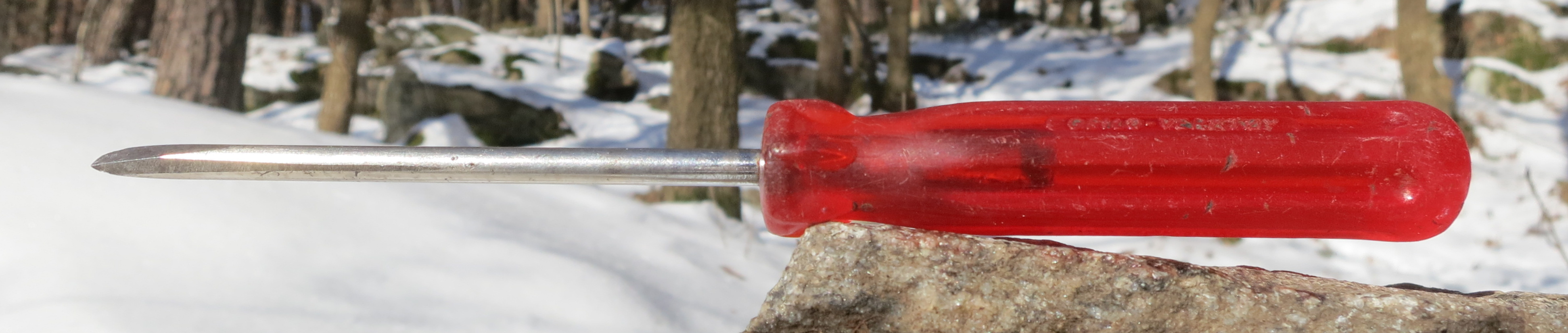
Red-handled screwdriver on a rock outdoors (Source: Wikimedia Commons)
Socket Sets: Provide leverage and access to hard-to-reach fasteners, common in hotel maintenance workshops.
Torque Wrenches: Allow precise application of torque to fasteners, preventing over-tightening in medical device repairs.
Pliers: Grip and twist wires or fasteners, useful in field repairs for cooperative societies.
Proper tightening prevents loose connections that can cause overheating or electrical failures. Maintenance teams at county referral hospitals use torque wrenches to maintain manufacturer specifications on critical equipment.
Keeping tightening tools clean and free of rust ensures smooth operation. For instance, bank maintenance personnel regularly check tools for wear and replace damaged screwdrivers to avoid stripping fasteners.
Explain five advantages of digital instruments over analogue instruments in electrical maintenance. (10 marks)
Describe five types of indicating tools and their specific uses in maintenance work. (10 marks)
List and explain five electrical measurement tools used in electronic equipment servicing. (10 marks)
Outline five safety practices to observe when using cutting tools during maintenance. (10 marks)
Discuss five types of tightening tools and their importance in securing electrical components. (10 marks)
Create a free account to open more of this chapter.
Free: practical guides, quick cards, workplace scenarios and more.
Create a free accountThis chapter explored the classification of tools and instruments essential for electrical and electronic equipment maintenance, covering analogue and digital instruments, indicating tools, measurement devices, cutting tools, and tightening tools. It detailed the various specification ranges that electrical tools and instruments must meet to ensure accuracy and safety during maintenance tasks. The chapter emphasized the importance of calibration for instruments to maintain precision and reliability in measurements. Additionally, it examined the materials commonly used in power supply installations, focusing on cables and printed circuit boards (PCBs), highlighting their roles and characteristics. Understanding these components and tools is fundamental for effective maintenance practices. The chapter provided a comprehensive foundation for assembling the correct tools, equipment, and materials necessary for electrical and electronic maintenance work.
Type: Individual
| Tools & Equipment | Materials |
|---|---|
| Multimeter | Electrical Tape |
| Insulated Screwdriver Set | Label Tags |
| Side Cutter | |
| Combination Pliers | |
| Wire Stripper | |
| Phase Tester | |
| Voltage Detector Pen | |
| Digital Clamp Meter |
| S/N | Item | Quantity |
|---|---|---|
| 1 | Multimeter | 1 Pc per Candidate |
| 2 | Insulated Screwdriver Set | 1 Set per Candidate |
| 3 | Side Cutter | 1 Pc per Candidate |
| 4 | Combination Pliers | 1 Pc per Candidate |
| 5 | Wire Stripper | 1 Pc per Candidate |
| 6 | Phase Tester | 1 Pc per Candidate |
| 7 | Electrical Tape | 1 Roll per Candidate |
| 8 | Label Tags | 5 Pcs per Candidate |
| 9 | Voltage Detector Pen | 1 Pc per Candidate |
| 10 | Digital Clamp Meter | 1 Pc per Candidate |
| Items to be Evaluated | Marks Available | Marks Obtained | Comments |
|---|---|---|---|
| TASK 1: Identification and Classification of Electrical Tools and Instruments | |||
| Wore Personal Protective Equipment (Dustcoat/Overall) (Award 1 mark if worn correctly, otherwise 0) | 1 | ||
| Ensured clean and safe working area before starting (Award 1 mark if working area is clean and safe, otherwise 0) | 1 | ||
| Correctly identified Multimeter and explained its function (Award 2 marks for correct identification and explanation, otherwise 0) | 2 | ||
| Correctly identified Insulated Screwdrivers and explained their use (Award 2 marks for correct identification and explanation, otherwise 0) | 2 | ||
| Correctly identified Side Cutter and explained its purpose (Award 2 marks for correct identification and explanation, otherwise 0) | 2 | ||
| Correctly identified Combination Pliers and explained their use (Award 2 marks for correct identification and explanation, otherwise 0) | 2 | ||
| Correctly identified Wire Stripper and explained its function (Award 2 marks for correct identification and explanation, otherwise 0) | 2 | ||
| Correctly identified Phase Tester and explained its use (Award 2 marks for correct identification and explanation, otherwise 0) | 2 | ||
| Correctly identified Voltage Detector Pen and explained its purpose (Award 2 marks for correct identification and explanation, otherwise 0) | 2 | ||
| Correctly identified Digital Clamp Meter and explained its function (Award 2 marks for correct identification and explanation, otherwise 0) | 2 | ||
| Properly labeled each tool with appropriate label tags (Award 2 marks if all tools are correctly labeled, otherwise 0) | 2 | ||
| Sub-Total | 20 | ||
| PRODUCT CHECKLIST | |||
| All electrical tools and instruments correctly classified and labeled (Award 10 marks if all tools are correctly classified and labeled, otherwise 0) | 10 | ||
| Sub-Total | 10 | ||
| GRAND TOTAL | 30 | ||
Type: Individual
| Tools & Equipment | Materials |
|---|---|
| Analogue Multimeter | Resistors (100 Ω, 1 kΩ, 10 kΩ) |
| Digital Multimeter | DC Power Supply 12 V, 3 A |
| Test Leads (Red and Black) | Connecting Wires |
| Set of Screwdrivers | Breadboard |
| Personal Protective Equipment (Dustcoat/Overall and Safety Gloves) |
| S/N | Item | Quantity |
|---|---|---|
| 1 | Analogue Multimeter | 1 Pc per Candidate |
| 2 | Digital Multimeter | 1 Pc per Candidate |
| 3 | Test Leads (Red and Black) 1.0 m | 1 Set per Candidate |
| 4 | Resistors (100 Ω, 1 kΩ, 10 kΩ) | 1 Set per Candidate |
| 5 | DC Power Supply 12 V, 3 A | 1 Pc per 5 Candidates |
| 6 | Connecting Wires 1 mm2, assorted colours | 2 m per Candidate |
| 7 | Breadboard | 1 Pc per Candidate |
| 8 | Set of Screwdrivers | 1 Set per Candidate |
| 9 | Personal Protective Equipment (Dustcoat/Overall and Safety Gloves) | 1 Set per Candidate |
| Items to be Evaluated | Marks Available | Marks Obtained | Comments |
|---|---|---|---|
| TASK 1: Safety and Preparation | |||
| Wore Personal Protective Equipment (Dustcoat/Overall and Safety Gloves) (Award 1 if worn correctly, otherwise 0) | 1 | ||
| Ensured clean and organized working area before starting the task (Award 1 if area is clean and tools arranged properly, otherwise 0) | 1 | ||
| Sub-Total | 2 | ||
| TASK 2: Equipment Identification and Setup | |||
| Identified and selected appropriate measuring instruments (analogue and digital multimeters) (Award 1 if correct instruments identified and selected, otherwise 0) | 1 | ||
| Connected the test circuit correctly on the breadboard using resistors and connecting wires (Award 2 if circuit connections are correct and firm, otherwise 0) | 2 | ||
| Set the analogue multimeter correctly for voltage, current, and resistance measurements (Award 2 if settings are correct for each measurement, otherwise 0) | 2 | ||
| Set the digital multimeter correctly for voltage, current, and resistance measurements (Award 2 if settings are correct for each measurement, otherwise 0) | 2 | ||
| Sub-Total | 7 | ||
| TASK 3: Measurement and Recording | |||
| Measured voltage across the resistor using the analogue multimeter and recorded the reading (Award 3 if measurement is accurate and properly recorded, otherwise 0) | 3 | ||
| Measured current through the resistor using the analogue multimeter and recorded the reading (Award 3 if measurement is accurate and properly recorded, otherwise 0) | 3 | ||
| Measured resistance of the resistor using the analogue multimeter and recorded the reading (Award 3 if measurement is accurate and properly recorded, otherwise 0) | 3 | ||
| Measured voltage across the resistor using the digital multimeter and recorded the reading (Award 3 if measurement is accurate and properly recorded, otherwise 0) | 3 | ||
| Measured current through the resistor using the digital multimeter and recorded the reading (Award 3 if measurement is accurate and properly recorded, otherwise 0) | 3 | ||
| Measured resistance of the resistor using the digital multimeter and recorded the reading (Award 3 if measurement is accurate and properly recorded, otherwise 0) | 3 | ||
| Sub-Total | 18 | ||
| TASK 4: Post-Measurement and Clean-up | |||
| Turned off and safely disconnected all equipment after measurements (Award 1 if done safely, otherwise 0) | 1 | ||
| Returned all tools and materials to designated storage areas (Award 1 if tools and materials are properly stored, otherwise 0) | 1 | ||
| Ensured working area is clean and free from hazards (Award 1 if area is clean and safe, otherwise 0) | 1 | ||
| Sub-Total | 3 | ||
| PRODUCT CHECKLIST | |||
| Test circuit mounted correctly on a 200mm x 150mm breadboard with proper connections (Award 5 if circuit is correctly assembled and connections firm, otherwise 0) | 5 | ||
| Voltage measurements within ±5% of expected values for both analogue and digital meters (Award 5 if measurements are within tolerance, otherwise 0) | 5 | ||
| Current measurements within ±5% of expected values for both analogue and digital meters (Award 5 if measurements are within tolerance, otherwise 0) | 5 | ||
| Resistance measurements within ±5% of expected resistor values for both analogue and digital meters (Award 5 if measurements are within tolerance, otherwise 0) | 5 | ||
| Sub-Total | 20 | ||
| GRAND TOTAL | 50 | ||
At the start of this chapter we promised you would be able to:
Tick each one you can genuinely do.
So, are you there yet?
You're competent when you can confidently do 50% or more of what this chapter promised.
Sign in to record how you're doing.