What you will be able to do
By the end of this chapter, you will be able to:
- Conduct a market survey to understand which herbs and spices are in demand.
- Prepare a crop nursery correctly tailored to the specific type of herbs and spices you want to grow.
- Manage the crop nursery by following the specific needs of your herbs and spices.
- Select seeds for propagation that match the ecological requirements of your chosen herbs and spices.
- Follow all necessary safety measures to keep yourself and others safe while working.
- Identify the different parts of herbs and spices based on the crop type.
- Assemble the tools and equipment needed for planting and nursery work correctly.
- Choose a suitable planting site by interpreting soil analysis reports.
- Conserve soil and water effectively by applying proper agronomic practices.
- Perform soil sterilization safely and accurately according to soil analysis.
- Apply water for irrigation in the right way based on the needs of your crop.
Mastering these skills will help you grow healthy herbs and spices efficiently, ensuring a successful and sustainable production that meets market needs.
Propagating herb and spice seedlings in open environments is a critical skill for horticulture professionals in Kenya, where the diverse agro-climatic zones offer vast opportunities for cultivation. Understanding the proper procedures ensures not only the healthy establishment of crops but also the safety of workers and sustainability of production. This chapter focuses on essential occupational safety and health protocols alongside the practical approach of conducting market surveys to select suitable herbs and spices for propagation. These foundational elements support successful nursery management and informed decision-making in the production process.
1.1 Procedures for Occupational Safety and Health
In Kenya, horticulture workers face various occupational hazards including exposure to agrochemicals, physical injuries, and environmental risks. Implementing robust safety and health procedures protects workers, reduces downtime caused by accidents, and complies with national regulations such as the Occupational Safety and Health Act (OSHA) 2007. This section explores the essential safety practices that must be integrated into daily operations when propagating herbs and spices, ensuring a safe working environment within open-field nurseries or propagation sites.
1.1.1 Risk Identification and Hazard Assessment
Identifying potential risks and hazards is the first step in safeguarding workers during propagation activities. In the Kenyan horticultural context, common hazards include chemical exposure, sharp tools, and ergonomic strains.
Hazard Types Common in Herb and Spice Propagation
- Chemical Hazards: Use of pesticides and fungicides during seedling treatment exposes workers to toxic substances, which can cause respiratory issues or skin irritation.
- Physical Hazards: Injuries from handling sharp tools such as knives-pruning scissors, or hoes are frequent in nursery settings.
- Biological Hazards: Handling soil or organic matter may expose workers to harmful pathogens or allergens.
- Ergonomic Hazards: Repetitive bending, lifting, or awkward postures during planting can lead to musculoskeletal disorders.
- Environmental Hazards: Working under harsh sun exposure or in wet conditions increases risks of heat stress or slips and falls.
1.1.2 Personal Protective Equipment (PPE) Usage and Maintenance
Proper use of PPE is fundamental to minimizing exposure to hazards during propagation. PPE must be appropriate for the specific risks identified in the herb and spice nursery environment.
Essential PPE for Propagation Activities
- Gloves: Protect hands from cuts, chemicals, and soil-borne pathogens; must be resistant to agrochemicals used.
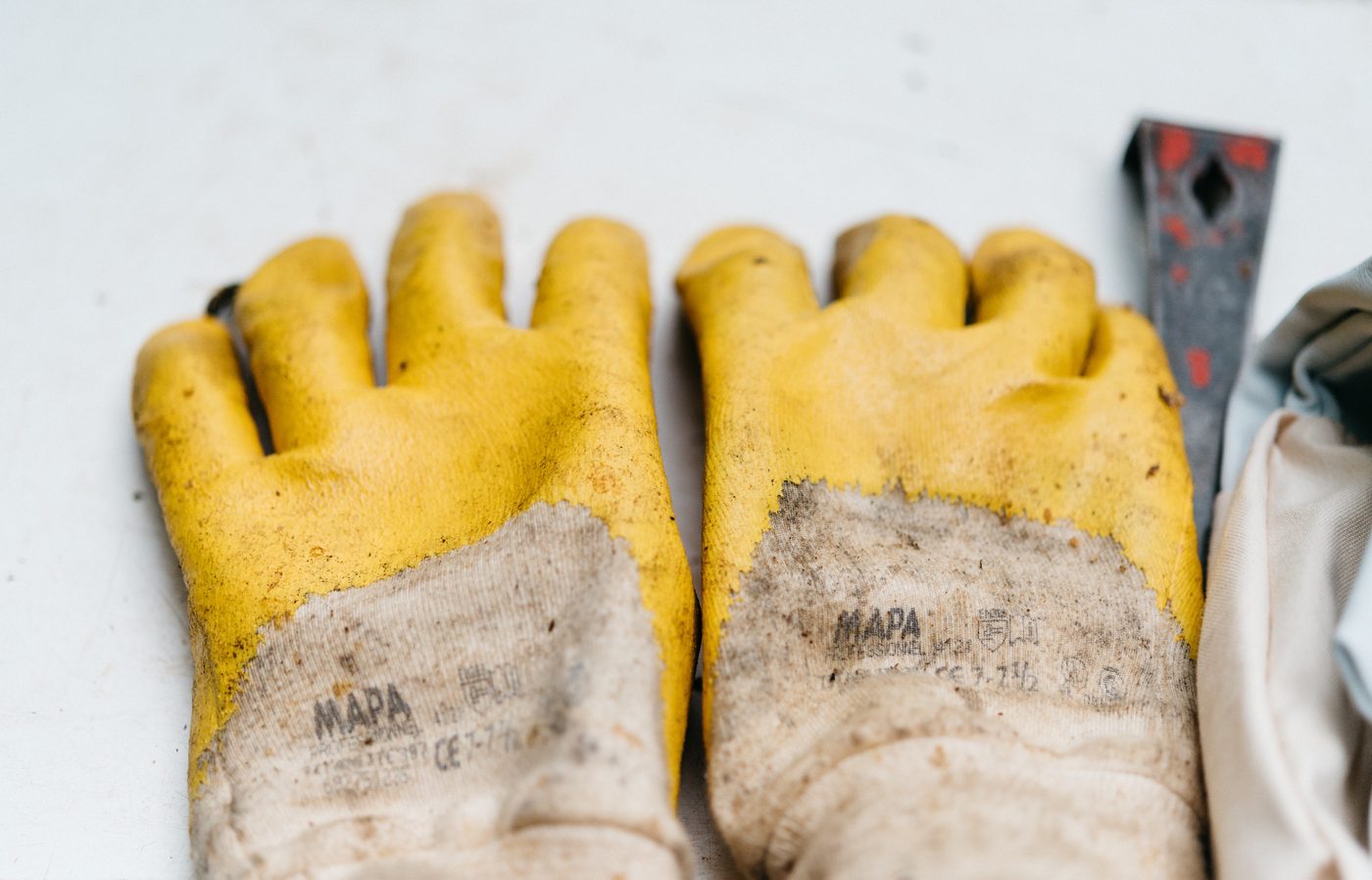
Pair of yellow work gloves used in carpentry (Source: Wikimedia Commons)
- Protective Clothing: Long-sleeved shirts and trousers shield skin from sunburn and chemical splashes.
- Face Masks or Respirators: Necessary when spraying chemicals or working in dusty conditions to prevent inhalation of harmful particles.
- Eye Protection: Safety goggles prevent chemical splashes and debris from injuring eyes.
- Footwear: Closed, slip-resistant boots protect feet from sharp objects and provide stability on uneven ground.
1.1.3 Safe Handling and Storage of Agrochemicals
Agrochemicals are widely used in propagation to control pests and diseases but pose significant health risks if mishandled. Safe handling and storage practices are essential to protect personnel and the environment.
Guidelines for Agrochemical Safety
- Label Reading: Workers must be trained to read and understand labels for correct dosage and handling instructions.
- Proper Mixing and Application: Chemicals should be mixed in well-ventilated areas using recommended protective gear.
- Storage: Agrochemicals must be stored in locked, clearly marked areas away from water sources and direct sunlight to prevent contamination and degradation.
- Disposal: Containers and unused chemicals must be disposed of following environmental regulations to avoid soil and water pollution.
- Spill Management: Immediate containment and cleanup procedures must be in place to handle accidental spills safely.
1.1.4 Emergency Preparedness and First Aid
Preparedness for emergencies such as chemical spills, injuries, or heat-related illnesses is vital for minimizing harm in propagation sites. Adequate first aid facilities and trained personnel reduce the severity of incidents.
Components of Emergency Preparedness
-
First Aid Kits: Should be accessible and stocked with supplies to treat cuts, burns, and chemical exposures.
-
Emergency Contacts: Displayed prominently with numbers for local health facilities and emergency services.
- Training: Workers must receive training in first aid, emergency procedures, and use of fire extinguishers.
- Incident Reporting: A system for documenting and investigating accidents supports continuous improvement in safety measures.
- Shelter and Hydration: Provision of shaded rest areas and clean drinking water reduces risks of heat stress during propagation work.
Practice Questions
- Explain five types of hazards that horticulture workers face during the propagation of herbs and spices. (10 marks)
- Describe the key components of personal protective equipment necessary for safe handling of agrochemicals in herb propagation. (10 marks)
- Outline six steps that should be taken to ensure safe storage and disposal of agrochemicals in a herb nursery. (12 marks)
- Discuss the importance of emergency preparedness in the propagation of herb seedlings and list four critical components of an emergency response plan. (8 marks)
Create a free account to open more of this chapter.
Free: practical guides, quick cards, workplace scenarios and more.
Create a free accountChapter Summary
This chapter provides a comprehensive guide to propagating herbs and spices seedlings in an open environment, beginning with essential occupational safety and health procedures to ensure a safe working environment. It emphasizes the importance of conducting a market survey to identify suitable herbs and spices for cultivation. The chapter explores various planting materials, detailing their types, sources, and preparation methods. It also discusses the diverse uses of herbs and spices, alongside a basic overview of plant anatomy to aid understanding of growth processes. Classification of herbs and spices into annual, perennial, and biennial categories is explained to assist in selecting appropriate species for propagation. The necessary tools, equipment, supplies, and materials are outlined, followed by soil and water conservation measures including soil sterilization and erosion control to maintain nursery health. Different types of nurseries are described, with factors for site selection and nursery bed preparation highlighted as critical steps. The chapter further examines propagation materials such as seeds, cuttings, rhizomes, root tubers, and splits, and details nursery management practices along with the importance of record keeping and waste management. Finally, it introduces emerging trends like automated sowing machines that enhance efficiency in seedling propagation.
Self-Assessment
A. Written Assessment
- What are the key occupational safety and health procedures to observe when propagating herb seedlings? (3 marks)
- Identify three factors to consider when conducting a market survey for herbs and spices. (3 marks)
Chapter Examination Questions
SECTION A (40 Marks) - Answer ALL Questions
- Explain four procedures for occupational safety and health that a horticulture worker must observe when propagating herb and spice seedlings at a county government farm in Kenya. (4 marks)
- Identify and explain four key factors to consider when conducting a market survey for suitable herbs and spices in Kenya’s retail herbal markets. (4 marks)
Chapter Practical Activities
Practical 1: Conduct a market survey for suitable herbs and spices and document their uses
Type: Individual
| Tools & Equipment | Materials |
|---|---|
| Notebook | Dust coat |
| Pen | Gumboots |
| Smartphone with camera | Face mask |
| Measuring tape 5m | Gloves |
| Digital voice recorder |
| S/N | Item | Quantity |
|---|---|---|
| 1 | Notebook | 1 Pc per Candidate |
| 2 | Pen | 1 Pc per Candidate |
| 3 | Smartphone with camera | 1 Pc per Candidate |
| 4 | Measuring tape 5m | 1 Pc per Candidate |
| 5 | Digital voice recorder | 1 Pc per 3 Candidates |
| 6 | Dust coat | 1 Pc per Candidate |
| 7 | Gumboots | 1 Pair per Candidate |
| 8 | Face mask | 1 Pc per Candidate |
| 9 | Gloves | 1 Pair per Candidate |
| Items to be Evaluated | Marks Available | Marks Obtained | Comments |
|---|---|---|---|
| TASK 1: Conduct market survey and document findings | |||
| Wore the correct Personal Protective Equipment: Dust coat, Gumboots, Face mask, Gloves (Award 1 mark for each PPE worn or 0) | 4 | ||
| Assembled the correct tools and equipment for survey (Award 2 marks if all tools assembled or 0) | 2 | ||
| Interviewed at least five market stakeholders (e.g. traders, farmers, consumers) (Award 1 mark per stakeholder interviewed or 0) | 5 | ||
| Recorded data accurately using notebook, voice recorder or smartphone (Award 1 mark for each recording method used correctly or 0) | 4 | ||
| Measured or estimated market quantities or demand using measuring tape or data collection (Award 3 marks if market demand data collected or 0) | 3 | ||
| Sub-Total | 18 | ||
| PRODUCT CHECKLIST | |||
| Report lists at least five suitable herbs and spices with correct common uses documented (Award 1.2 marks per herb/spice correctly listed with use or 0) | 6 | ||
| Report includes estimated market demand or potential for each herb/spice (Award 4 marks if demand data present and realistic or 0) | 4 | ||
| Report is clearly written, well organized and legible (Award 2 marks for clarity and organization or 0) | 2 | ||
| Sub-Total | 12 | ||
| GRAND TOTAL | 30 | ||
Practical 2: Identify and classify herbs and spices seedlings into annual, perennial, and biennial categories
Type: Individual
| Tools & Equipment | Materials |
|---|---|
| Magnifying glass | |
| Plant identification guidebook for herbs and spices | |
| Notebook | |
| Pen | |
| Adhesive labels | |
| Marker pen |
| S/N | Item | Quantity |
|---|---|---|
| 1 | Herb and spice seedlings specimens (e.g. basil, coriander, rosemary, parsley, dill) | 10 seedlings per Candidate |
| 2 | Magnifying glass | 1 Pc per Candidate |
| 3 | Plant identification guidebook for herbs and spices | 1 Pc per Candidate |
| 4 | Notebook | 1 Pc per Candidate |
| 5 | Pen | 1 Pc per Candidate |
| 6 | Adhesive labels | 10 Pcs per Candidate |
| 7 | Marker pen | 1 Pc per Candidate |
| 8 | Dust coat | 1 Pc per Candidate |
| 9 | Gumboots | 1 Pair per Candidate |
| 10 | Gloves | 1 Pair per Candidate |
| 11 | Face mask | 1 Pc per Candidate |
| Items to be Evaluated | Marks Available | Marks Obtained | Comments |
|---|---|---|---|
| TASK 1: Prepare and use PPE | |||
| Wore dust coat (Award 1 mark if worn, 0 if not) | 1 | ||
| Wore gumboots (Award 1 mark if worn, 0 if not) | 1 | ||
| Wore gloves (Award 1 mark if worn, 0 if not) | 1 | ||
| Wore face mask (Award 1 mark if worn, 0 if not) | 1 | ||
| Sub-Total | 4 | ||
| TASK 2: Assemble tools and specimens | |||
| Collected all 10 herb and spice seedlings specimens (Award 2 marks if all collected, 0 if fewer) | 2 | ||
| Assembled magnifying glass, guidebook, notebook, pen, adhesive labels and marker pen (Award 2 marks if all assembled, 0 if incomplete) | 2 | ||
| Sub-Total | 4 | ||
| TASK 3: Identify and classify seedlings | |||
| Examined plant anatomy features (leaves, stems, roots) using magnifying glass (Award 3 marks for thorough examination, 0 if not done) | 3 | ||
| Correctly identified each seedling species using guidebook (Award 5 marks if all correctly identified, 0 if fewer) | 5 | ||
| Classified seedlings accurately into annual, perennial, and biennial categories (Award 6 marks if classification matches botanical standards, 0 if incorrect) | 6 | ||
| Sub-Total | 14 | ||
| TASK 4: Label seedlings | |||
| Prepared and attached adhesive labels with correct category names (Award 3 marks if labels are clear and correctly placed, 0 if not) | 3 | ||
| Recorded classification details legibly in notebook (Award 3 marks if all entries are legible and accurate, 0 if incomplete) | 3 | ||
| Sub-Total | 6 | ||
| TASK 5: Clean up | |||
| Returned tools and specimens to designated place (Award 2 marks if done properly, 0 if not) | 2 | ||
| Disposed of any waste properly (Award 2 marks if done properly, 0 if not) | 2 | ||
| Sub-Total | 4 | ||
| PRODUCT CHECKLIST | |||
| All 10 seedlings correctly identified and classified into annual, perennial, and biennial categories (Award 8 marks if all classifications are correct, 0 if not) | 8 | ||
| Labels are correctly and neatly attached with accurate category names (Award 4 marks if labels are neat and accurate, 0 if not) | 4 | ||
| Classification recorded clearly and accurately in notebook (Award 4 marks if records are clear and correct, 0 if not) | 4 | ||
| Sub-Total | 16 | ||
| GRAND TOTAL | 48 | ||
At the start of this chapter we promised you would be able to:
- Conduct a market survey to understand which herbs and spices are in demand.
- Prepare a crop nursery correctly tailored to the specific type of herbs and spices you want to grow.
- Manage the crop nursery by following the specific needs of your herbs and spices.
- Select seeds for propagation that match the ecological requirements of your chosen herbs and spices.
- Follow all necessary safety measures to keep yourself and others safe while working.
- Identify the different parts of herbs and spices based on the crop type.
- Assemble the tools and equipment needed for planting and nursery work correctly.
- Choose a suitable planting site by interpreting soil analysis reports.
- Conserve soil and water effectively by applying proper agronomic practices.
- Perform soil sterilization safely and accurately according to soil analysis.
- Apply water for irrigation in the right way based on the needs of your crop.
Tick each one you can genuinely do.
Sample simulation — try how the simulator works. A version built for this chapter's practical is coming.
Prepare Kenyan PilauLocked ▸Free: practical guides, quick cards, workplace scenarios and more.
Now — are you there yet?
You're competent when you can confidently do 50% or more of what this chapter promised.
Sign in to record how you're doing.